
Best Food Processors (Expert Consensus)
Last reviewed: 2026-04-14
(This page is updated periodically as expert recommendations and market conditions change.)
Disclosure: This page contains affiliate links. If you buy through our links, we may earn a commission. This does not influence our recommendations or rankings.
Category Overview & Market Context
What This Category Is
A food processor is a countertop kitchen appliance that uses interchangeable blades and discs to chop, slice, shred, purée, and mix ingredients. Full-size models typically range from 7 to 16 cups in capacity and can handle demanding tasks like kneading bread dough, shredding blocks of cheese, and slicing vegetables in seconds. Mini food processors (3-5 cup capacity) are smaller, lighter alternatives designed for quick tasks like chopping herbs, making sauces, or grinding nuts.
State of the Market
The food processor market is dominated by a handful of established brands — Cuisinart, Breville, KitchenAid, Hamilton Beach, and Ninja — each targeting different price points and use cases. Cuisinart, which introduced the food processor to the American market in the early 1970s, remains the most widely recommended brand across expert sources. Breville has established itself as the performance leader with its Sous Chef and newer Paradice lines. The category has seen relatively slow innovation compared to categories like blenders or air fryers, with most advances focused on quieter motors, improved slicing precision, and better storage solutions for accessories.
Who This Is For / Not For
A food processor is worth the counter space for anyone who regularly chops vegetables, shreds cheese, makes dips or sauces, or kneads dough. It can reduce prep time from minutes to seconds for tasks that would otherwise require a sharp knife and a cutting board. If you only cook occasionally or primarily make smoothies and soups, a blender may be a better fit — food processors excel at textured results rather than smooth liquids. Mini food processors suit cooks with limited space or those who primarily need to chop small batches of herbs, nuts, or garlic.
How This Review Was Produced
This review is based on expert consensus rather than a single reviewer’s opinion.
We analyze and synthesize recommendations from multiple independent expert review sources that meet our editorial quality and transparency standards. We document where experts agree, where they differ, and why. No single source determines our recommendations.
We do not conduct original product testing. Instead, we rely on experts who do — such as publications that perform hands-on testing, lab measurements, or clearly documented evaluation methodologies.
Manufacturers do not influence our recommendations. Advertising, affiliate relationships, or commercial considerations do not affect which products are included, how they are ranked, or how they are described.
When helpful, we also consult additional secondary review outlets to understand how broader expert opinion aligns — or conflicts — with the primary consensus. These secondary sources do not determine winners but may provide context or confirmation.
Top Picks at a Glance
Best Full-Size Food Processor
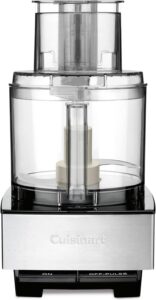
Cuisinart Custom 14-Cup Food Processor
The most consistently recommended food processor across expert sources, valued for its simplicity, durability, and reliable performance across all standard tasks.
Best Budget Food Processor
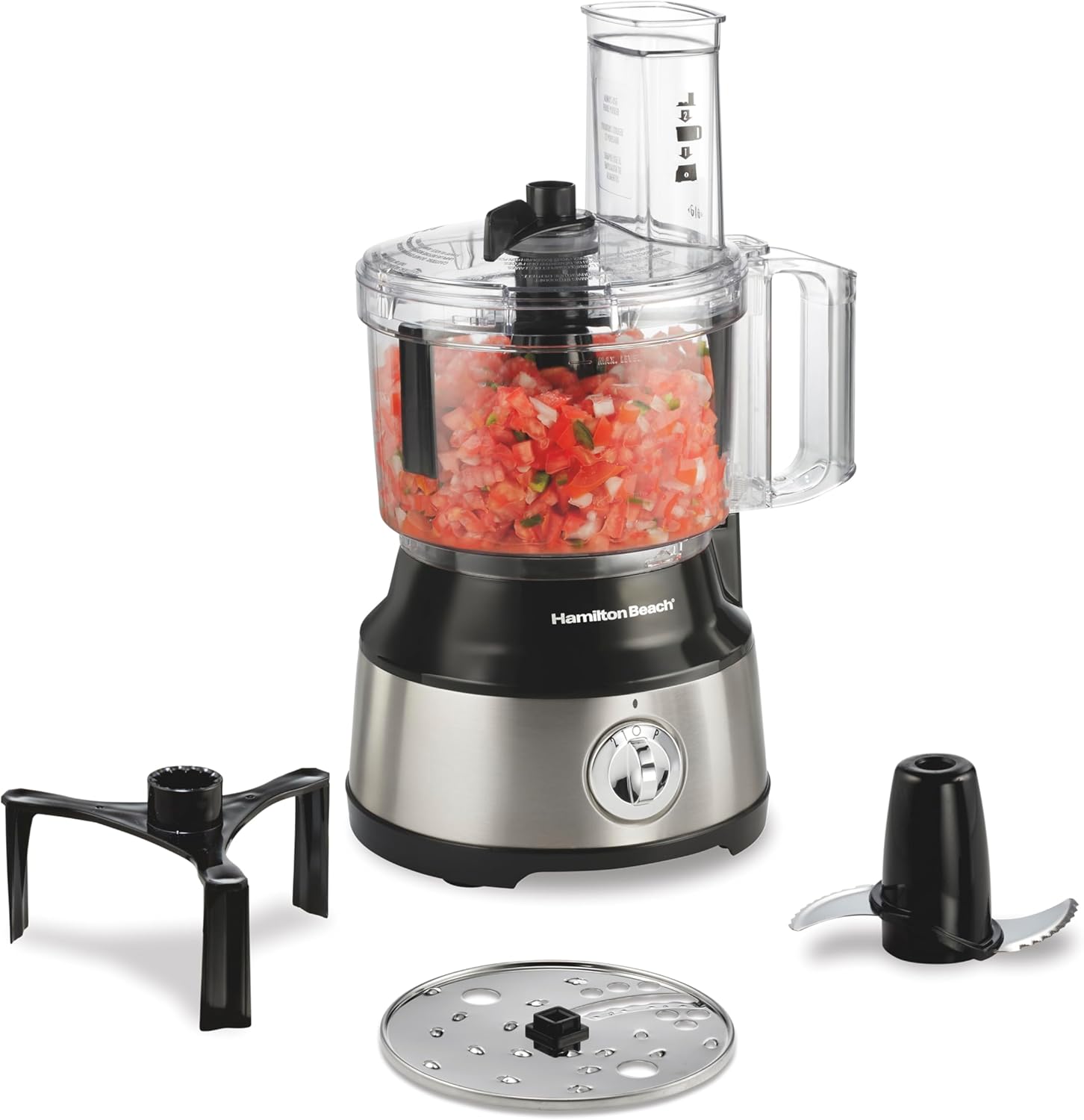
Hamilton Beach 10-Cup Food Processor
A capable entry-level food processor with a built-in bowl scraper and adequate performance for basic chopping, slicing, and shredding at a fraction of premium prices.
Best Mini Food Processor
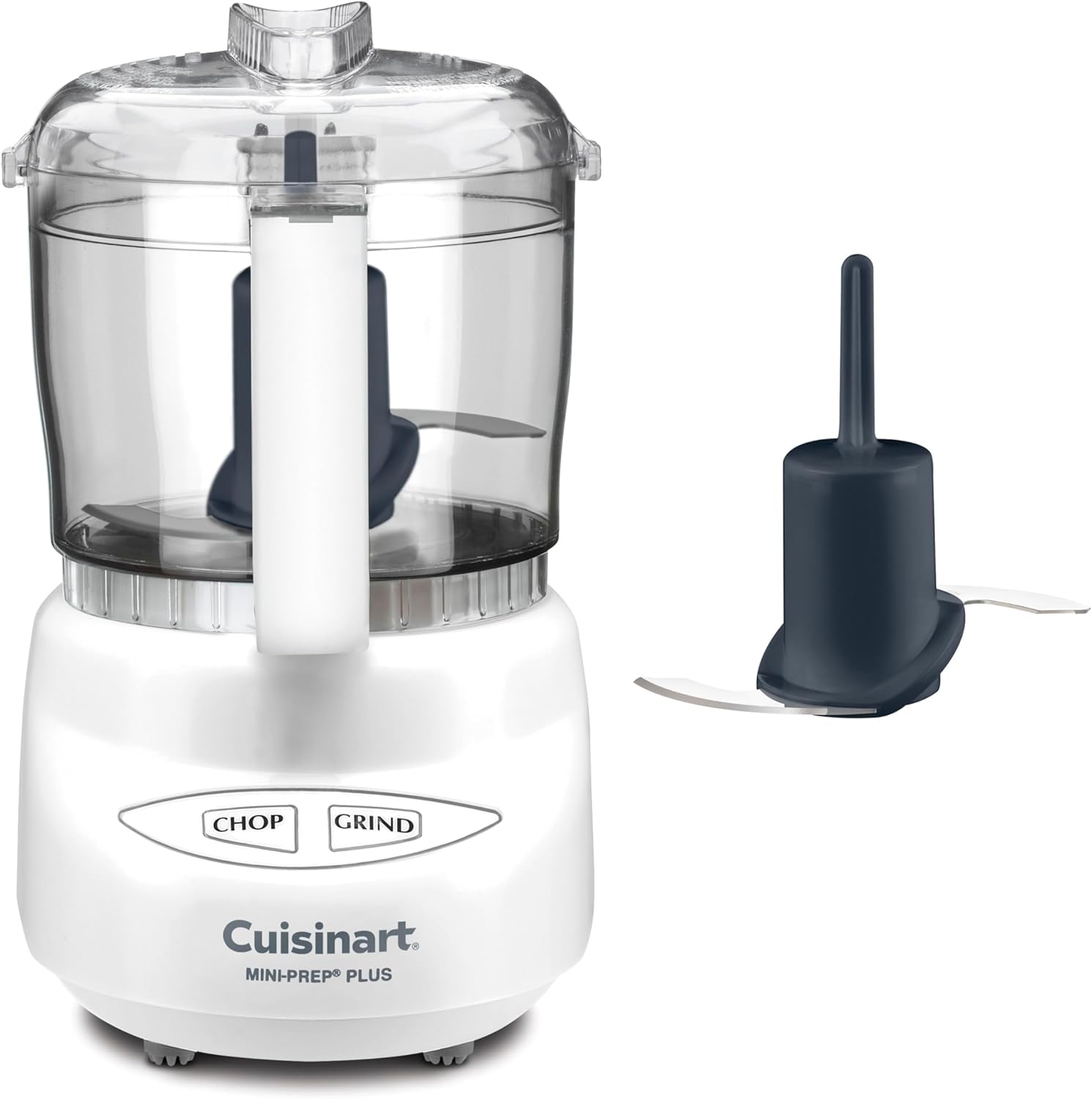
Cuisinart Mini-Prep Plus Food Processor
A compact, affordable mini processor well suited for quick chopping and grinding tasks when a full-size model is unnecessary.
Top Picks in Detail
Below are our recommendations explained in more depth, including why experts agree and where each pick has trade-offs.
Best Full-Size Food Processor: Cuisinart Custom 14-Cup Food Processor
BEST FULL-SIZE FOOD PROCESSOR
Cuisinart Custom 14-Cup Food Processor
The most broadly recommended food processor across independent expert sources. Its simple two-button design, powerful 720-watt motor, and proven durability make it an effective workhorse for chopping, slicing, shredding, and kneading. Experts consistently praise its no-frills reliability and long service life.
If you buy through our links, we may earn a commission. This doesn’t affect our recommendations.
Why It’s a Top Pick
The Cuisinart Custom 14-Cup Food Processor demonstrates the strongest cross-source consensus of any product in this category. Wirecutter names it Top Pick and has recommended it since 2013, noting that the machine’s simplicity does not come at the cost of performance. America’s Test Kitchen (ATK) designates it Winner, calling it “powerful, precise, and compact” and noting it takes up less space than most food processors despite having one of the largest capacities. The Spruce Eats names it Best Overall after testing more than 20 food processors. Consumer Reports rates it among its top food processors, awarding it a top score for shredding and noting it is one of the quietest models tested.
Secondary sources reinforce this consensus. Tom’s Guide, CNN Underscored, Forbes Vetted, and The Strategist all independently name it Best Overall. Serious Eats recommends it as Best Budget among full-size processors, positioning it as a top-tier recommendation at a lower price point than Breville alternatives.
The design philosophy is deliberately minimal: two lever controls (On and Pulse), one 14-cup bowl, and three essential attachments (S-blade, slicing disc, shredding disc). Wirecutter notes this makes the machine easier to use and clean than models with more settings or multiple bowls. The 720-watt motor handles demanding tasks — including kneading pizza dough and shredding hard cheeses — without stalling. Multiple reviewers report multi-decade service life, and Cuisinart’s replacement parts program extends the machine’s useful lifespan further.
What Experts Like
- Simple, reliable design with just two buttons and three essential attachments — nothing unnecessary
- Powerful 720-watt motor handles everything from delicate herbs to dense dough without overheating
- Exceptional durability with multi-decade service life reported across sources
- One of the quietest full-size food processors in Consumer Reports’ testing
- 14-cup capacity accommodates large batches while remaining compact enough for cabinet storage
Trade-Offs to Consider
- Slicing disc is not adjustable — cuts at a single fixed thickness, unlike the Breville’s 24-setting adjustable disc
- Lever controls may feel less intuitive than pushbutton interfaces for some users
- Less raw power than the Breville Sous Chef 16, which may matter for very dense doughs or large-volume processing
- Parts and motor warranty varies by retailer — some sources note a shorter warranty than competitors
Runners-Up
Two strong alternatives emerged from the expert consensus, each suited to different priorities.
- Breville Sous Chef 16 — The clear performance leader across testing sources. Good Housekeeping Institute names it Best Overall after testing more than 85 food processors, and TechGearLab reaches the same conclusion after 30-plus individual tests per model. Wirecutter designates it Upgrade Pick. Its 1,450-watt motor, adjustable 24-setting slicing disc, and 5.5-inch feed chute deliver exceptional precision and power. It didn’t win because it carries a significant price premium and is, as Wirecutter notes, “far more than most people need.” ATK recommends it for those with the space and budget but positions the Cuisinart as its top pick. Its large footprint also limits it to cooks with dedicated counter space. Note: Breville replaced the earlier Sous Chef 16 Pro (BFP800XL) with the current Sous Chef 16 (BFP810), which features an upgraded 1,450-watt motor (from 1,200 watts) and an impact-resistant BPA-free bowl.
- KitchenAid KFP1318 13-Cup Food Processor — Reviewed names it Best Overall after hands-on retesting, and Consumer Reports rates it among the top performers for chopping and shredding. At 8.3 pounds, it is the lightest full-size processor available, making it a compelling choice for cooks who store their machine in a cabinet. The snap-and-go assembly and in-bowl storage caddy add practical convenience. It didn’t win because it has narrower cross-source support than the Cuisinart, and its 500-watt motor is less powerful for demanding tasks like kneading heavy dough.
Best Budget Food Processor: Hamilton Beach 10-Cup Food Processor
BEST BUDGET FOOD PROCESSOR
Hamilton Beach 10-Cup Food Processor
The Hamilton Beach 10-Cup delivers functional food processing at a fraction of premium prices. Its built-in bowl scraper keeps ingredients close to the blades for more even results, and its 10-cup capacity handles most everyday cooking needs.
If you buy through our links, we may earn a commission. This doesn’t affect our recommendations.
Why It’s a Top Pick
The Hamilton Beach 10-Cup Food Processor is the most consistently identified budget option across expert sources. TechGearLab names it Best on a Tight Budget after lab testing that includes more than 30 individual assessments per model. Consumer Reports includes it among its rated food processors with acceptable marks for chopping, slicing, and shredding. Multiple Secondary sources — Tom’s Guide, CNN Underscored, and CNET — independently name Hamilton Beach as the Best Budget food processor after hands-on testing.
The distinguishing feature is the built-in bowl scraper, which moves side to side during processing to keep ingredients near the blades. This reduces the need to stop and manually scrape the bowl, a common annoyance with budget processors. The 10-cup capacity is adequate for most home cooking, and the included stainless steel S-blade and reversible slicing/shredding disc cover the core food-processing tasks.
What Experts Like
- Built-in bowl scraper keeps ingredients close to blades for more even processing without stopping
- 10-cup capacity is generous for a budget model, handling most everyday cooking needs
- Large feed chute accommodates whole blocks of cheese and large vegetables with less pre-cutting
- Compact footprint does not dominate counter space
Trade-Offs to Consider
- The 450-watt motor struggles with dense doughs and hard vegetables, and the unit can shake noticeably under heavy loads
- The plastic bowl may develop scratches over time, and some testers report leaking during liquid-heavy tasks
- Noisier than premium models during operation
- Less even chopping and slicing results compared to the Best Full-Size segment winner
Runners-Up
- Black+Decker 8-Cup Food Processor — Reviewed names it Best Value, noting it chops, minces, slices, and kneads dough well for the price. Its easy-assembly design and dishwasher-safe parts add convenience. It didn’t win because it has single-source Primary support, and the 8-cup capacity and 450-watt motor are more limiting than the Hamilton Beach for larger tasks.
Best Mini Food Processor: Cuisinart Mini-Prep Plus Food Processor
BEST MINI FOOD PROCESSOR
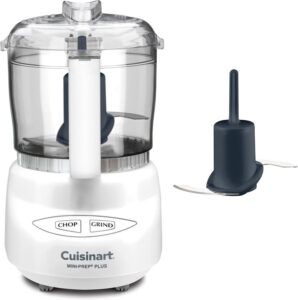
Cuisinart Mini-Prep Plus Food Processor
A compact, affordable mini processor with a patented auto-reversing blade that handles both chopping and grinding. Good Housekeeping Institute names it Best Mini after extensive lab testing.
If you buy through our links, we may earn a commission. This doesn’t affect our recommendations.
Moderate Consensus Note: Expert sources show less agreement on mini food processors than on full-size models. Multiple distinct Cuisinart mini models appear across different sources, preventing consensus consolidation around a single product. This pick reflects the strongest available agreement, but readers with specific needs may benefit from exploring alternatives. The runner-up below offers a different design approach.
Why It’s a Top Pick
The Cuisinart Mini-Prep Plus is named Best Mini by Good Housekeeping Institute, which has tested more than 85 food processors across all sizes in its Kitchen & Cooking Lab. Forbes Vetted also names it Best Mini, and The Strategist recommends it as a less expensive mini option. The Mini-Prep Plus is the most widely available and affordable Cuisinart mini processor, with a simple two-function design (Chop and Grind) powered by its patented auto-reversing SmartPower blade. The 250-watt motor handles soft and hard foods in the 24-ounce work bowl, and all removable parts are dishwasher-safe.
What Experts Like
- Compact, lightweight design that stores easily in a drawer or small cabinet
- Auto-reversing blade provides two processing modes (Chop and Grind) without changing attachments
- Dishwasher-safe bowl and lid for easy cleanup
- Touchpad controls wipe clean easily
Trade-Offs to Consider
- Reviewed found it to be one of the loudest mini food processors tested
- Defaults to pulsing only — no continuous-run mode, requiring constant button presses for extended processing
- The 24-ounce (3-cup) capacity limits batch size — one medium onion at most per cycle
- The 18-month warranty is shorter than some competitors
Runners-Up
- KitchenAid 3.5-Cup Food Chopper — ATK names it Best Buy for small food processors, praising its durability, quick performance without overprocessing, and sharp blade coverage. The Strategist recommends it for easy cleaning and minimal debris-trapping nooks. Its drizzle basin makes it a good choice for mayonnaise, dressings, and sauces. It didn’t win because it has narrower cross-source support than the Cuisinart and a slightly smaller capacity.
How to Choose the Right Food Processor for You
Decide what size you actually need. Full-size food processors range from about 7 to 16 cups in capacity. A 14-cup model handles large batches for family meals, batch cooking, and entertaining, while a 7-9 cup model suits smaller households. Mini food processors (3-5 cups) are designed for quick tasks like chopping herbs, making sauces, or grinding small quantities — they will not replace a full-size model for slicing, shredding, or dough work.
Consider motor power relative to your tasks. Motors range from 250 watts in mini processors to over 1,400 watts in premium full-size models. A 450-watt motor handles everyday chopping and slicing adequately, but may struggle with dense bread dough or hard root vegetables. If you regularly knead dough, process large volumes, or work with tough ingredients, a motor of 700 watts or higher provides a meaningful performance advantage.
Think about attachments and what you will actually use. Every food processor includes an S-blade for chopping. Most add a slicing disc and a shredding disc. Premium models may include dough blades, adjustable slicing discs, French fry cutters, and julienne discs. More attachments add versatility but also add storage bulk and cleanup time. Sources like Wirecutter and ATK favor processors that include only the most useful attachments without unnecessary extras — S-blade, slicing disc, shredding disc — and adding specialty attachments later if needed.
Factor in ease of cleaning and storage. Food processors with fewer crevices, dishwasher-safe parts, and simple locking mechanisms make regular use more appealing. Models with in-bowl storage caddies (like the KitchenAid KFP1318) or dedicated storage containers (like the Breville Sous Chef 16) keep accessories organized. Smaller, lighter machines are easier to move in and out of cabinets for those who do not keep the processor on the counter full-time.
Weigh noise levels if you have an open kitchen or sensitive household. Consumer Reports tests noise across all models and notes significant variation. If noise is a concern, prioritize models rated well for quiet operation — the Cuisinart Custom 14-Cup is among the quietest full-size processors tested.
How We Make Our Recommendations
Our recommendations follow a documented, repeatable editorial process designed to prioritize expert agreement, comparability, and clarity.
For each category, we:
- Define clear category scope and exclusions
- Identify and vet independent expert review sources
- Inventory all products reviewed across those sources
- Analyze patterns of agreement and disagreement
- Apply editorial judgment only after consensus is documented
When a category includes materially different product types, we segment recommendations rather than forcing a single “best overall.” For more information, see How We Work.
Sources & Citations
Primary Sources
- America’s Test Kitchen, The Best Food Processors, March 2024 [subscription required]
- America’s Test Kitchen, The Best Small Food Processors, Aug. 2024 [subscription required]
- Bon Appétit, Only One Food Processor Earned Our Stamp of Approval After Testing 16 Models, Dec. 2025
- Consumer Reports, 7 Best Food Processors and Choppers of 2026, Lab-Tested and Reviewed, March 2026 [subscription required]
- Consumer Reports, Food Processor & Chopper Buying Guide, May 2025 [subscription required]
- Consumer Reports, Food Choppers Ratings & Reviews [subscription required]
- Consumer Reports, Food Processors Ratings & Reviews [subscription required]
- Good Housekeeping Institute, Our Kitchen Lab Tested Over 80 Food Processors — These Are the Best 8 Right Now, Feb. 2026
- Reviewed, The Best Food Processors of 2026, Oct. 2025
- Reviewed, The Best Mini Food Processors of 2026, March 2024
- Serious Eats, Pulse! Pulverize! These Are the 9 Best Food Processors, Dec. 2025
- TechGearLab, The Best Food Processors, June 2025
- The Spruce Eats, We Tested 20+ Food Processors and These 10 Shredded the Competition, June 2025
- Wirecutter, The Best Food Processor, Sept. 2025
Secondary Sources Consulted for Context
- CNET, Best Food Processors of 2026: KitchenAid, Cuisinart and More, April 2025
- CNN Underscored, The best food processors for fast and easy kitchen prep, tested and reviewed, Jan. 2026
- Eater, The Best Food Processors, According to Chefs Who Use Them Every Single Day, March 2025
- Epicurious, The Best Food Processor for All Your Kitchen Prep Tasks, March 2025
- Forbes Vetted, The 5 Best Food Processors That Slice, Dice And Pulverize With Ease, May 2025
- The Strategist, The 7 Very Best Food Processors, April 2025
- Tom’s Guide, Best food processors: expert tested and rated, Nov. 2025
Additional Sources Reviewed
- Allrecipes, Ditch Your Weak Food Processor — This Model Is My Secret for Easier Food Prep, May 2025
- Food & Wine, I’ve Always Owned a Cuisinart Food Processor, and This Is Why I Always Will, Jan. 2025
- Taste of Home, We Tested 8 Models To Find the Best Food Processors for Every Kitchen, Feb. 2026
Updates & Ongoing Review
This review is monitored on an ongoing basis. We update recommendations when expert sources publish new test results, products are discontinued, or consensus meaningfully changes.
Version History
- 2026-04-14 — Initial publication