
Best Air Conditioners (Expert Consensus)
Last reviewed: 2026-04-08
(This page is updated periodically as expert recommendations and market conditions change.)
Disclosure: This page contains affiliate links. If you buy through our links, we may earn a commission. This does not influence our recommendations or rankings.
Category Overview & Market Context
What This Category Is
This review covers consumer-installable room air conditioners — specifically window air conditioners and portable air conditioners that plug into a standard outlet and cool a single room or area. These units are the most accessible cooling option for renters, homeowners without central air, and anyone who needs targeted relief from summer heat without professional installation.
State of the Market
The room air conditioner market has evolved significantly in recent years. Inverter compressor technology — which adjusts cooling output rather than cycling on and off — has moved from a premium feature to a mainstream expectation, delivering quieter operation and meaningfully better energy efficiency. U-shaped and inverted U-shaped window designs now let homeowners keep their windows functional while the AC is installed, a major quality-of-life improvement over traditional box units. Smart connectivity with app control, voice assistants, and scheduling has become standard across mid-range and premium models. In 2025, Midea issued a recall on its popular U-shaped window units due to potential mold growth, prompting updated designs and repair kits that have since been incorporated into newer production runs.
Who This Is For / Not For
This review is for consumers shopping for a room-level cooling solution they can install themselves. It covers both window-mounted units (the most efficient option for most situations) and portable units (best when window installation is not possible due to building restrictions or window type). This review does not cover central air conditioning systems, professionally installed ductless mini-split systems, evaporative coolers, or fans (see Best Cooling Fans). Also, most of these systems do not purify the air. See Best Air Purifiers if that is what you need.
How This Review Was Produced
This review is based on expert consensus rather than a single reviewer’s opinion.
We analyze and synthesize recommendations from multiple independent expert review sources that meet our editorial quality and transparency standards. We document where experts agree, where they differ, and why. No single source determines our recommendations.
We do not conduct original product testing. Instead, we rely on experts who do — such as publications that perform hands-on testing, lab measurements, or clearly documented evaluation methodologies.
Manufacturers do not influence our recommendations. Advertising, affiliate relationships, or commercial considerations do not affect which products are included, how they are ranked, or how they are described.
When helpful, we also consult additional secondary review outlets to understand how broader expert opinion aligns — or conflicts — with the primary consensus. These secondary sources do not determine winners but may provide context or confirmation.
Top Picks at a Glance
Best Window Air Conditioner
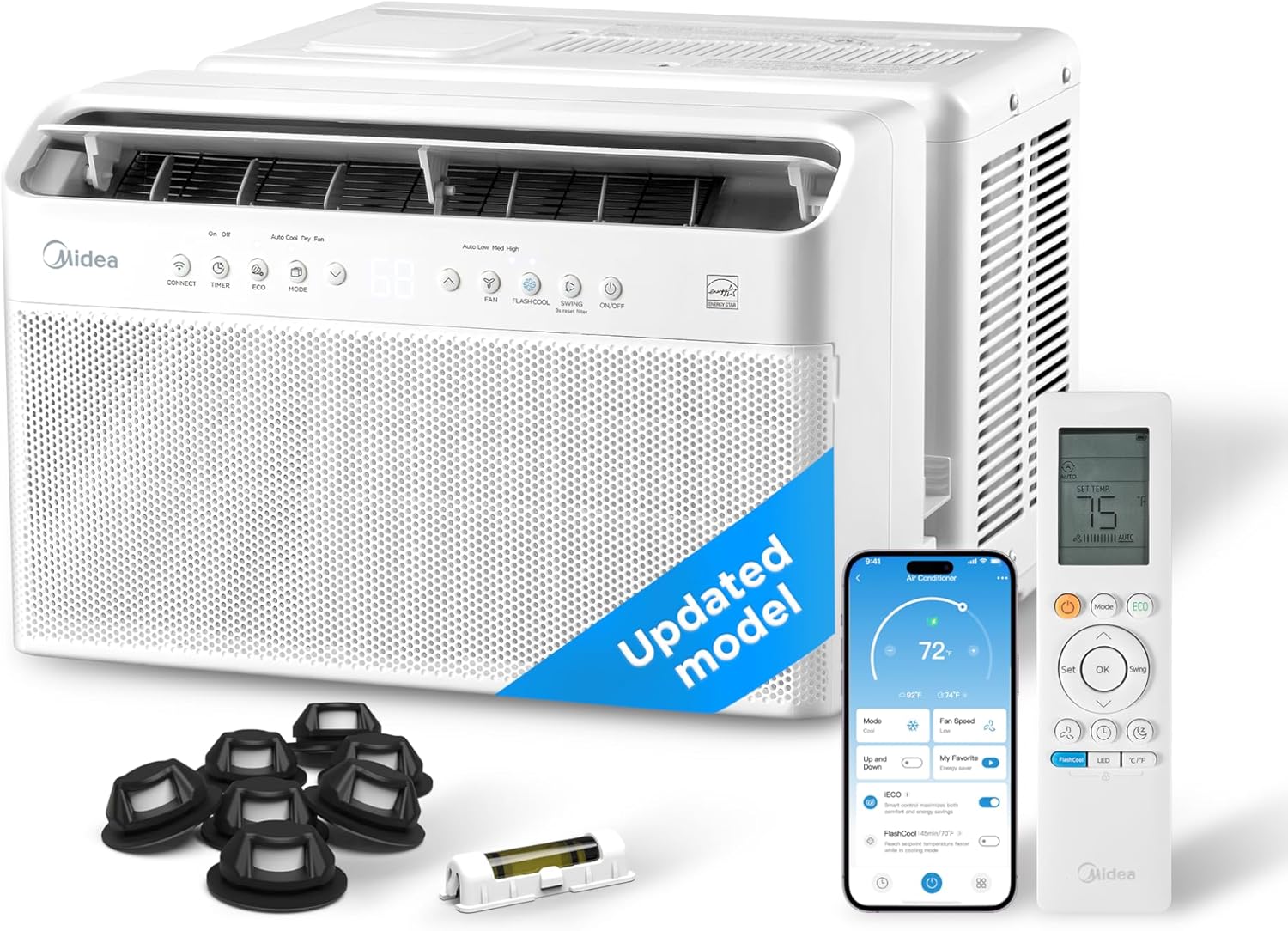
Midea U MAW08V1QWT
The quietest and most energy-efficient window AC across our expert sources, with a unique U-shaped design that lets you keep your window functional while staying cool.
Best Portable Air Conditioner
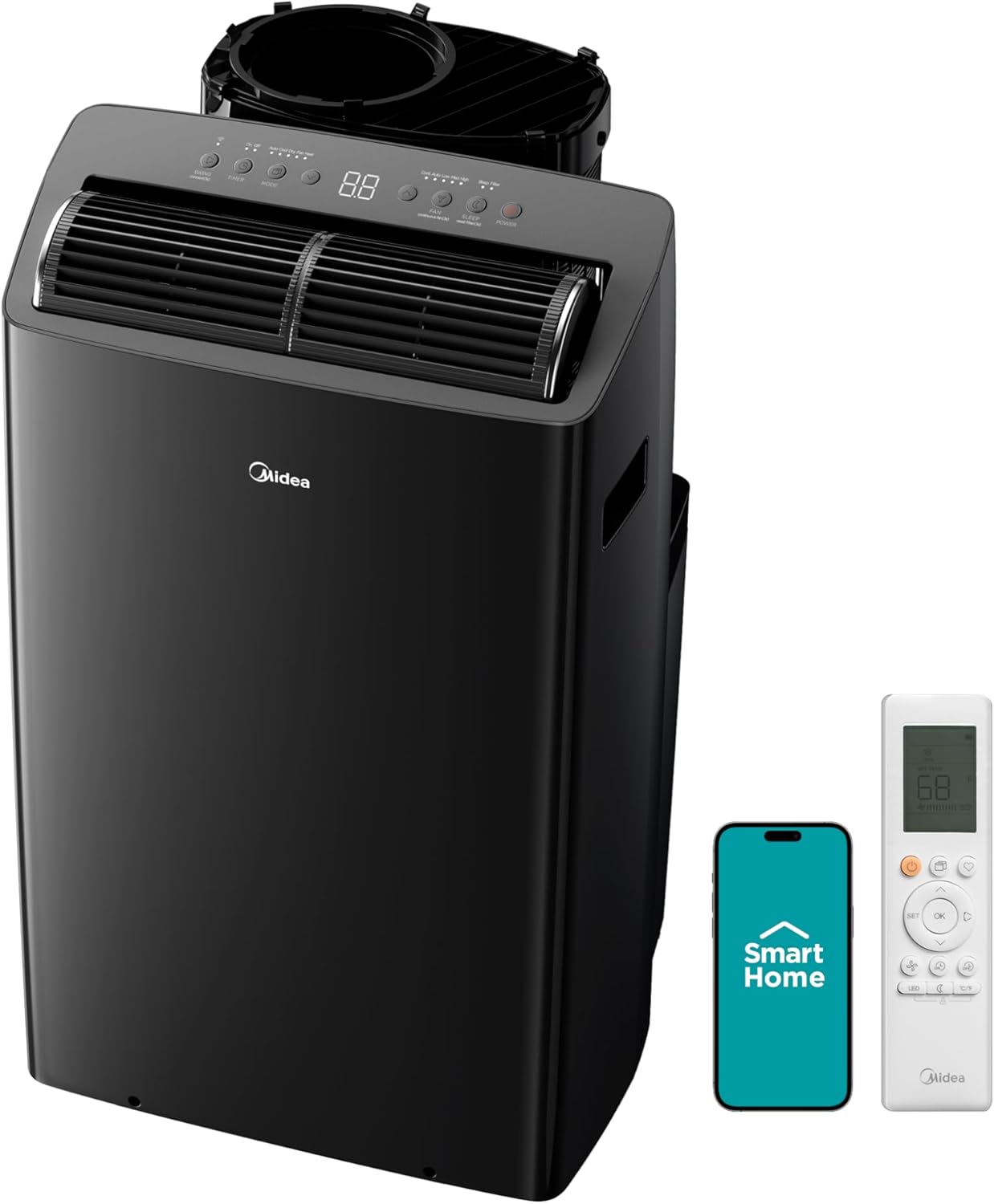
Midea Duo MAP14HS1TBL
A dual-hose portable with inverter technology that delivers stronger, more efficient cooling than traditional single-hose units, with smart controls and year-round heating capability.
Top Picks in Detail
Below are our recommendations explained in more depth, including why experts agree and where each pick has trade-offs.
Best Window Air Conditioner: Midea U MAW08V1QWT
BEST WINDOW AIR CONDITIONER
Midea U MAW08V1QWT
Experts across multiple independent publications consistently identify the Midea U as the top window air conditioner for most people. Its U-shaped design isolates compressor noise outside the window, delivering remarkably quiet operation, while inverter technology provides significant energy savings over traditional units. Smart connectivity through the Midea app, Alexa, and Google Assistant adds convenient remote control.
If you buy through our links, we may earn a commission. This doesn’t affect our recommendations.
Why It’s a Top Pick
The Midea U has been Wirecutter’s Top Pick since 2020 and remains one of the most broadly endorsed window air conditioners in expert testing. Consumer Reports (CR) rates U-shaped Midea variants at 90 out of 100 in both the 8,000 BTU (British Thermal Unit) and 12,000 BTU tiers, placing them among the highest-scoring window ACs in CR’s program. BTUs measure cooling capacity — the higher the number, the larger the space a unit can cool effectively. RTINGS names the 12,000 BTU variant its Best Overall window AC, noting excellent cooling capacity and a noise score of 9.0 out of 10. TechGearLab calls the Midea Smart MAW08HV1CWT — a closely related variant — the Best Overall window AC in its lab testing of 15 models, praising its energy efficiency and quiet operation. Bob Vila’s testers rank the Midea 12,000 BTU U-shaped as Best Overall in their dedicated U-shaped AC roundup, and WIRED and Tom’s Guide both select the Midea U as their overall top pick after months of real-world use.
In June 2025, Midea issued a voluntary recall of its U-shaped air conditioners due to reports of potential mold growth in some units. The company has since updated the design on newer production runs, offered free repair kits for older units, and provided prorated refunds as an alternative. Post-recall models include updated drain plugs and a bubble level to help ensure proper installation tilt for drainage. Wirecutter, RTINGS, CR, and Bob Vila all continue to recommend the Midea U after the recall, noting that the updated drainage design should mitigate the issue for most users.
What Experts Like
- The U-shaped design allows you to open and close your window while the AC is installed, unlike traditional window units that lock the window shut all summer
- Inverter compressor technology delivers energy savings that experts estimate at 35% or more compared to traditional window ACs, earning Energy Star Most Efficient certification
- Operation as quiet as 32 dBA makes this one of the quietest window ACs available, with multiple sources confirming it is significantly quieter than traditional units
- Smart home integration through Wi-Fi, the Midea app, Alexa, and Google Assistant provides convenient scheduling and remote control
Trade-Offs to Consider
- Installation is more complex and heavier than traditional window ACs, typically requiring two people and careful bracket alignment
- The 2025 mold recall, while addressed with updated designs and repair kits, may concern buyers who prefer units without a recall history
- Not compatible with all window types — casement windows and some non-standard frames may not accommodate the U-shaped design
- Cooling performance in TechGearLab’s lab testing was respectable but did not lead the pack among 8,000 BTU models, suggesting the unit’s strengths are efficiency and noise rather than raw cooling speed
Runners-Up
While the Midea U earns the broadest expert support, several other window ACs stood out during our research and are strong alternatives depending on your priorities.
- Frigidaire Gallery GHWW085TE1 — This inverter-powered 8,000 BTU unit earns high marks from both Wirecutter, which names it Best for Air Quality, and CR, which rates it 90 out of 100 in the mid-size tier. Business Insider selects it as Best Overall in its testing of 14 window units. It offers quiet operation at 41 dBA, smart app control, and an auto-swing louver for even air distribution. Its Combined Energy Efficiency Ratio (CEER) rating of 15 places it among the most efficient models available. It does not offer the Midea U’s window-open functionality, and its coverage is limited to the 8,000 BTU range.
- LG LW8024IVSM — CR’s highest-rated window AC at 92 out of 100 in the mid-size tier, this LG Dual Inverter model earns top marks for both reliability and owner satisfaction in CR’s member survey. Good Housekeeping selects an LG 8,000 BTU model as its Best Overall, and The Strategist names the LG Dual Inverter its overall top pick after years of personal testing. Its primary limitation as a consensus winner is narrower cross-source coverage — it is not a top pick at Wirecutter, RTINGS, or TechGearLab. Stock availability is limited at some retailers.
Best Portable Air Conditioner: Midea Duo MAP14HS1TBL
BEST PORTABLE AIR CONDITIONER
Midea Duo MAP14HS1TBL
The most frequently recommended portable AC across expert sources, the Midea Duo uses an innovative dual hose-in-hose design and inverter technology to deliver stronger, more efficient cooling than traditional single-hose portables. It also provides heating for year-round use and integrates with smart assistants for convenient control.
If you buy through our links, we may earn a commission. This doesn’t affect our recommendations.
Why It’s a Top Pick
A note on portable air conditioners: experts broadly agree that window ACs outperform portable units in cooling efficiency, noise, and energy use. CR’s lab tests find that no portable model earns a full recommendation, and multiple sources advise choosing a window unit when possible. Portable ACs are best suited for situations where window installation is not feasible — such as buildings that prohibit window units, casement or sliding windows, or spaces where temporary cooling is needed.
The Midea Duo MAP14HS1TBL is Wirecutter’s Top Pick for portable ACs and Bob Vila’s Best Overall after hands-on Florida testing. Reviewed names it Best High Efficiency portable. Forbes Vetted selects it as Best Overall after a month of rigorous real-world testing in Florida heat, and CNET names the closely related MAP14HS1TBL its Best High-End pick after lab testing of 10 models. The cooling-only variant, the MAP12S1TBL, is CR’s top-rated portable at 73 out of 100 and TechGearLab’s Best Overall after testing nine portables. The Midea Duo’s innovative hose-in-hose dual design addresses one of the fundamental weaknesses of portable ACs: single-hose models create negative air pressure that pulls warm air back into the room, undermining cooling efficiency. The Duo’s design eliminates this problem, and multiple sources report it cools rooms noticeably faster and more evenly than single-hose competitors.
What Experts Like
- The hose-in-hose dual design prevents the negative pressure problem that limits single-hose portables, resulting in meaningfully stronger real-world cooling
- Inverter technology provides energy savings that Midea estimates at over 40% compared to federal standards, with sources confirming lower energy draw than most portables tested
- Ultra-quiet operation at 42 dBA during cooling, which multiple testers note is remarkably quiet for a portable unit
- Four-in-one functionality — cooling, heating, dehumidification, and fan modes — provides year-round climate control in a single unit
Trade-Offs to Consider
- Carries a significant price premium over single-hose portables and is among the most expensive portable ACs on the market
- Heavy at approximately 75 pounds, making it difficult to move between rooms or floors despite its caster wheels
- Portable ACs are inherently less efficient than window units — even this dual-hose model cannot match the cooling performance of a comparably rated window AC
- Initial setup of the hose and window kit takes more time and effort than some simpler single-hose competitors
Runners-Up
If the Midea Duo’s premium positioning or size does not fit your needs, these alternatives offer strong performance at different priorities.
- Whynter ARC-14S — Reviewed selects this dual-hose portable as its Best for Most People, and Bob Vila names it Runner-Up after hands-on Florida testing. Forbes Vetted picks it as Best Dual-Hose. Its eco-friendly CFC-free refrigerant and activated carbon filter appeal to environmentally conscious buyers. It lacks the Midea Duo’s inverter technology and smart home connectivity, and it is louder and less energy-efficient, but it delivers reliable dual-hose cooling at a lower price point.
- Black+Decker BPACT14WT — CNN Underscored names this its Best Overall portable after testing seven units, praising its excellent cooling performance and value. Wirecutter selects it as its Budget Pick. Its single-hose design is simpler to set up than dual-hose models, and its smart features including app control and voice assistant compatibility are unusual at its price point. The trade-off is lower efficiency and louder operation than dual-hose inverter units, and it is not available in California.
How to Choose the Right Air Conditioner for You
Decide between a window unit and a portable unit based on your living situation. Window air conditioners are more efficient, quieter, and generally more effective at cooling than portable units of comparable capacity. If you have a standard double-hung or single-hung window and your building allows it, a window AC is the better choice for most people. Portable ACs are best for situations where window installation is not possible — such as casement windows, building restrictions, or spaces where you need temporary, movable cooling.
Match the BTU capacity to your room size for efficient cooling. BTU stands for British Thermal Unit — it is the standard measurement of an air conditioner’s cooling power. An air conditioner that is too small will struggle to cool the space, while one that is too large will cool too quickly without properly removing humidity, leaving the room feeling cold and clammy. As a general guide: 5,000 to 6,500 BTU handles rooms up to 250 square feet, 7,000 to 8,500 BTU covers 250 to 350 square feet, and 9,800 to 12,500 BTU is appropriate for 350 to 550 square feet. Adjust upward for sunny rooms, kitchens, or spaces with high ceilings.
Understand the two BTU rating systems for portable ACs. Portable air conditioners are rated using two different standards, which can make comparison confusing. The ASHRAE (American Society of Heating, Refrigerating and Air-Conditioning Engineers) rating measures cooling under ideal laboratory conditions and produces the higher number you will typically see on the box. The DOE (Department of Energy) standard uses a metric called SACC (Seasonally Adjusted Cooling Capacity), which accounts for real-world factors like heat leaking back through the exhaust hose and warm outside air seeping in through gaps — conditions that every portable AC faces during actual use. The SACC rating is significantly lower than the ASHRAE number for the same unit, often 30 to 40% lower. For example, a portable AC rated at 14,000 BTU under ASHRAE may have an SACC rating of only 8,000 to 10,000 BTU. When comparing portable ACs, use the SACC rating for a more accurate picture of actual cooling performance in your home.
Prioritize inverter technology if noise and energy use matter to you. Inverter compressors adjust their speed to match cooling demand rather than cycling on and off, resulting in quieter operation, less temperature fluctuation, and lower energy consumption. Nearly all top-scoring ACs in expert testing now use inverter technology, and the energy savings can be substantial over a full summer of use.
Consider a U-shaped or inverted U-shaped design if you want to keep your window usable. These designs allow the window sash to close into a slot in the unit, putting a pane of glass between you and the compressor. This reduces indoor noise and lets you open and close the window for fresh air without removing the AC — a significant convenience advantage over traditional box-style units.
Look at the CEER rating to compare energy efficiency across window ACs. CEER stands for Combined Energy Efficiency Ratio — it measures how efficiently a window air conditioner converts electricity into cooling. A higher CEER number means better efficiency and lower operating costs. Models rated CEER 15 or above are among the most efficient on the market. Nearly all current models meet basic Energy Star requirements, but units labeled Energy Star Most Efficient offer the highest tier of efficiency and are worth seeking out if you plan to run the AC frequently.
Check your window dimensions and type before purchasing. Most window ACs are designed for double-hung or single-hung windows. Casement windows, sliding windows, and non-standard frames may not accommodate a window unit, in which case a portable or through-the-wall unit is the better option. Measure your window opening carefully, including width and sill depth, before buying.
How We Make Our Recommendations
Our recommendations follow a documented, repeatable editorial process designed to prioritize expert agreement, comparability, and clarity.
For each category, we:
- Define clear category scope and exclusions
- Identify and vet independent expert review sources
- Inventory all products reviewed across those sources
- Analyze patterns of agreement and disagreement
- Apply editorial judgment only after consensus is documented
When a category includes materially different product types, we segment recommendations rather than forcing a single “best overall.” For more information, see How We Work.
Sources & Citations
Primary Sources
- Bob Vila, 6 Small Window ACs That Take Minutes to Install and Seconds to Start Cooling, July 2025
- Bob Vila, Our Favorite Energy Efficient Air Conditioner Can Cool Almost Any Room, Aug. 2025
- Bob Vila, The Best Through-the-Wall Air Conditioners, July 2024
- Bob Vila, This Portable Air Conditioner is Worth Every Penny, April 2025
- Bob Vila, We Installed 5 U-Shaped Air Conditioners to Find the Best for Quiet, Efficient Cooling, May 2025
- Bob Vila, We Tested the Best Window ACs for Every Room, Budget, and Heat Wave, July 2025
- CNN Underscored, No central air? These are the best window air conditioners we’ve tested, Jan. 2026
- CNN Underscored, The best portable air conditioner in 2026, tried and tested, Jan. 2026
- Consumer Reports, Air Conditioner Buying Guide, Feb. 2026 [subscription required]
- Consumer Reports, Best Portable Air Conditioners, Jan. 2025 [subscription required]
- Consumer Reports, Best Quiet Window Air Conditioners from CR’s Tests, Sept. 2025 [subscription required]
- Consumer Reports, Best Window Air Conditioners of 2026, Feb. 2026 [subscription required]
- Consumer Reports, Portable Air Conditioners Ratings [subscription required]
- Consumer Reports, Window Air Conditioners Ratings [subscription required]
- Reviewed, The Best Portable Air Conditioners of 2026, June 2025
- Reviewed, The Best Window Air Conditioners of 2026, Feb. 2025
- RTINGS, The 3 Best Window Air Conditioners of 2026, March 2026
- RTINGS, The 4 Best Portable Air Conditioners of 2026, March 2026
- TechGearLab, 8 Best Air Conditioners of 2026, March 2026
- TechGearLab, Best Portable Air Conditioner, June 2025
- TechGearLab, Best Window Air Conditioners of 2026, March 2026
- Wirecutter, The Best Air Conditioner, July 2025
- Wirecutter, The Best Portable Air Conditioner, July 2025
Secondary Sources Consulted for Context
- Better Homes & Gardens, The 6 Best Air Conditioners Our Team Relies on to Beat the Heat, July 2025
- Business Insider, The best air conditioners of 2026, tested and reviewed, Aug. 2025
- CNET, Best Portable Air Conditioners: Cooling Your Home One Room at a Time, Aug. 2025
- Forbes Vetted, The 5 Best Portable ACs Of 2025 That Stood Up To The Florida Heat, Aug. 2025
- Good Housekeeping, The Best Window AC Units, According to Our Expert Tests, May 2025
- PCMag, The Best Smart Air Conditioners for 2026, March 2026
- The Spruce, We Tested the 5 Best Air Conditioners to Stay Sweat-Free, Oct. 2025
- The Strategist, There’s a New Generation of Window AC Units. We Found the Best Ones., April 2026
- Tom’s Guide, Best smart air conditioners to cool your home, July 2025
- Tom’s Guide, I tested this smart air conditioner on one of the hottest days of the year — and I was blown away by the results, July 2025
- WIRED, The Best Window Air Conditioners to Create a Cool Refuge From the Heat, Aug. 2025
Updates & Ongoing Review
This review is monitored on an ongoing basis. We update recommendations when expert sources publish new test results, products are discontinued, or consensus meaningfully changes.
Version History
- 2026-04-08 — Initial publication