
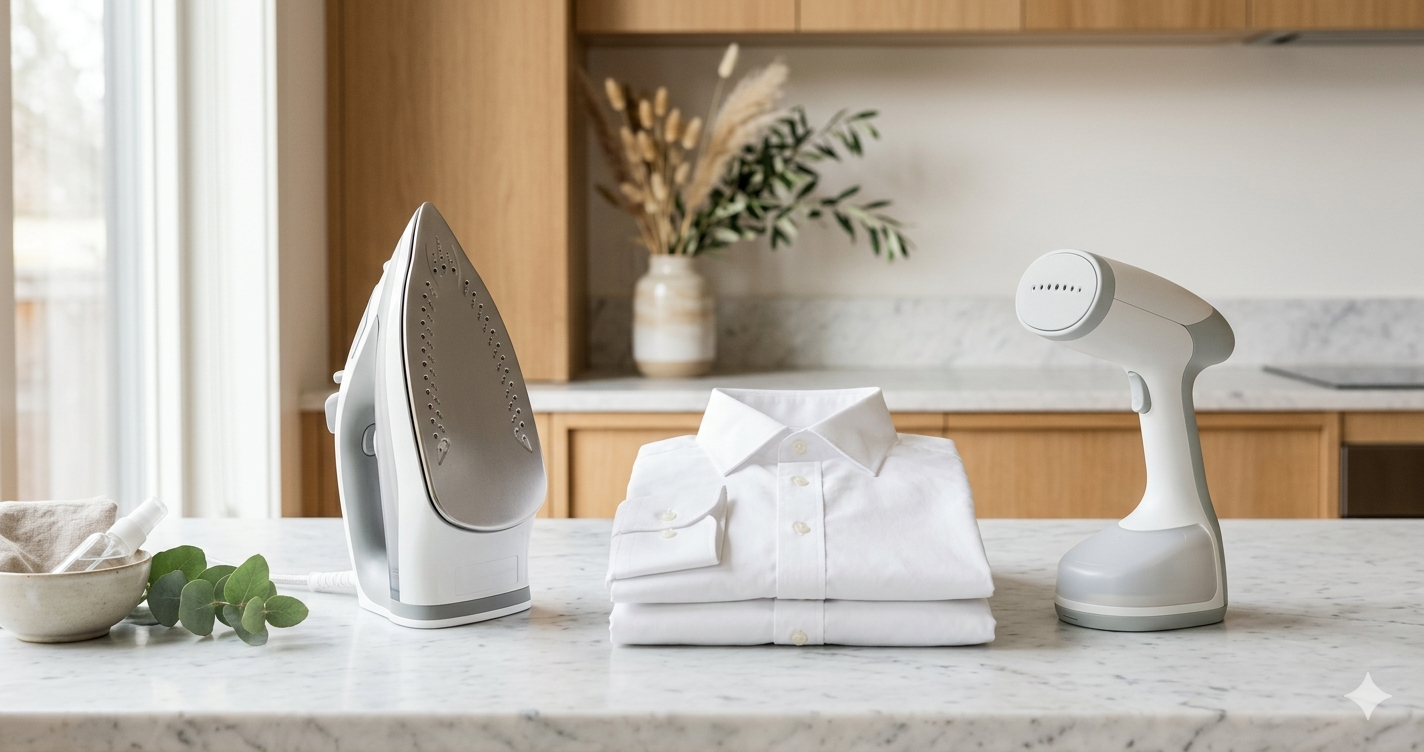
A practical guide to choosing between clothing irons and clothing steamers — based on what expert reviewers consistently recommend.

By: Michael Kuzma, Editor-in-Chief
Last Updated: May 2026
Somewhere between “I should probably look more presentable” and “I am not setting up an ironing board on a Tuesday morning,” there’s a product decision to make. Iron or steamer? They both remove wrinkles. They both use steam. And they both sit in a closet for months at a time if you buy the wrong one. The difference is in how they work, what they’re good at, and how much effort you’re willing to put into looking like you didn’t just pull something out of a suitcase.
After reading through what Wirecutter, Consumer Reports, Better Homes & Garden, TechGearLab, and others have to say, the answer is simpler than the internet makes it: irons and steamers are not interchangeable. They’re good at different things. Once you figure out what you actually need done to your clothes, the right choice becomes obvious.
The Short Version
If you need sharp creases, pressed collars, or truly flat fabric, you need an iron. Nothing else does this.
If you just need wrinkles gone from hanging clothes and you want it done fast with minimal setup, you want a steamer.
If you’re still not sure, keep reading. But honestly, for most people it comes down to that.
Irons
Best for: Dress shirts, slacks, linen, anything that needs to look crisp and pressed, and anyone who actually owns an ironing board.
An iron does something a steamer physically cannot: it applies heat and pressure simultaneously. That combination is what creates sharp creases in pants, flattens shirt collars, and makes cotton and linen look properly pressed rather than just de-wrinkled. If you wear dress shirts to work, own linen anything, or care about creased trousers, an iron is not optional.
Modern irons are better than whatever your parents had. The good ones pump steam through hundreds of micro-holes in the soleplate for even distribution, have precision tips for navigating around buttons and seams, and heat up fast enough that the process isn’t the ordeal it used to be.
The trade-off is the whole production involved. You need an ironing board. You need a flat surface. You need to lay out each piece, press it section by section, flip it, press the other side. It’s methodical work. Some people find it meditative. Most people find it tedious (including yours truly!). It takes 5-10 minutes per garment if you’re doing it properly, which adds up fast on a Sunday night when you’re prepping for the week.
Irons also carry a real risk of burning fabric if you use the wrong temperature setting. Silk on a cotton setting is a lesson you only need to learn once. The good ones have auto-shutoff and clear temperature guides, but the responsibility is still on you.
Who should skip them: Anyone whose wrinkle-removal needs are mostly “make this look less rumpled” rather than “make this look pressed.” If you’re steaming a casual shirt before dinner, you don’t need an ironing board for that. Also anyone who knows in their heart they’ll never set up an ironing board voluntarily. Self-knowledge, again, is an underrated shopping skill.
For specific models and expert consensus picks, see our full Best Clothing Irons review.
Steamers
Best for: Quick wrinkle removal, delicate fabrics, travel, and anyone who wants results without the ritual of setting up an ironing board.
A steamer does one thing and does it fast: it relaxes wrinkles out of fabric using hot steam. You hang the garment, run the steamer over it, and the wrinkles release. No ironing board, no flat surface, no flipping the garment over. Depending on the fabric, you can de-wrinkle a shirt in one to two minutes. For the “I have a meeting in 20 minutes and this looks like I slept in it” scenario, a steamer is a lifesaver.
Steamers also win on fabric safety. Because there’s no direct contact with a hot metal plate, there’s almost no risk of burning or scorching. This makes them the better choice for delicate fabrics like silk, chiffon, and synthetic blends where an iron would be risky. It’s also why dry cleaners and retail stores use them.
There are three types. Handheld steamers are the most popular for home use. They’re compact, heat up in under a minute, and store easily. The downside is a small water tank that gives you maybe 15-20 minutes of steam per fill, which is enough for a few garments but not a full wardrobe. Travel steamers are even smaller and lighter, designed to fit in a carry-on, but they trade tank size for portability (some give you only five minutes of steam). Standing steamers have large tanks that deliver up to 90 minutes of continuous steam, which is great if you steam a lot, but they take up real closet space and cost significantly more.
The thing steamers cannot do is press. They will not create a crease in your trousers. They will not make a dress shirt collar stand at attention. They will not flatten linen into that crisp, just-ironed look. They remove wrinkles, but the result is relaxed and smooth, not pressed and sharp. If that distinction matters to you, a steamer alone won’t cut it.
Some handheld steamers now come with a flat soleplate attachment that lets you press lightly against fabric, blurring the line between steaming and ironing. It’s a useful feature, but don’t mistake it for a replacement for a real iron. It’s more of a light touch-up than a proper press.
Who should skip them: Anyone who needs truly pressed, creased clothing. If your wardrobe is built around dress shirts and tailored pants that need to look sharp, a steamer is a complement to an iron, not a replacement. Also anyone who thinks they’ll use a travel steamer at home regularly. They’re designed for suitcases, not daily use. The tiny tank will drive you crazy.
For specific models and expert consensus picks, see our full Best Clothing Steamers review.
Do You Need Both?
Maybe. And that’s not a dodge.
If your wardrobe mixes dress shirts and casual clothes, the ideal setup is an iron for the pieces that need to look sharp and a steamer for the quick touch-ups on everything else. That sounds excessive, but in practice it means the iron comes out once a week for work shirts and the steamer handles the day-to-day stuff. Two tools, two different jobs.
If you’re picking just one, the deciding factor is your wardrobe:
Mostly business or formal wear? Iron. A steamer won’t get your shirts where they need to be.
Mostly casual clothes, knits, and synthetic blends? Steamer. You’ll use it more often because it’s faster and easier, and you probably don’t need the pressed look anyway.
Heavy traveler? A travel steamer for the road plus whatever you prefer at home. Irons in hotel rooms are universally terrible, and a compact steamer in your carry-on solves the problem permanently.
What Matters Less Than You Think
Wattage. Higher wattage generally means more steam output, but the differences between, say, 1500 watts and 1700 watts are marginal in practice. You won’t notice it in everyday use.
Steam output in grams per minute. This spec appears in every product listing and means almost nothing to a normal person. The real question is whether the steam penetrates the fabric effectively, and that depends more on soleplate design (for irons) or nozzle design (for steamers) than raw output numbers.
Vertical steam on irons. Most irons advertise a “vertical steam” feature where you can hold the iron upright and steam hanging garments. In theory, this gives you iron-and-steamer functionality in one device. In practice, holding a hot, heavy iron sideways while trying to steam a hanging shirt is awkward, tiring, and not nearly as effective as a purpose-built steamer. If you want a steamer, buy a steamer.
For expert consensus picks in each category, including specific model recommendations, trade-offs, and how the major review sources compare, see our detailed reviews: