
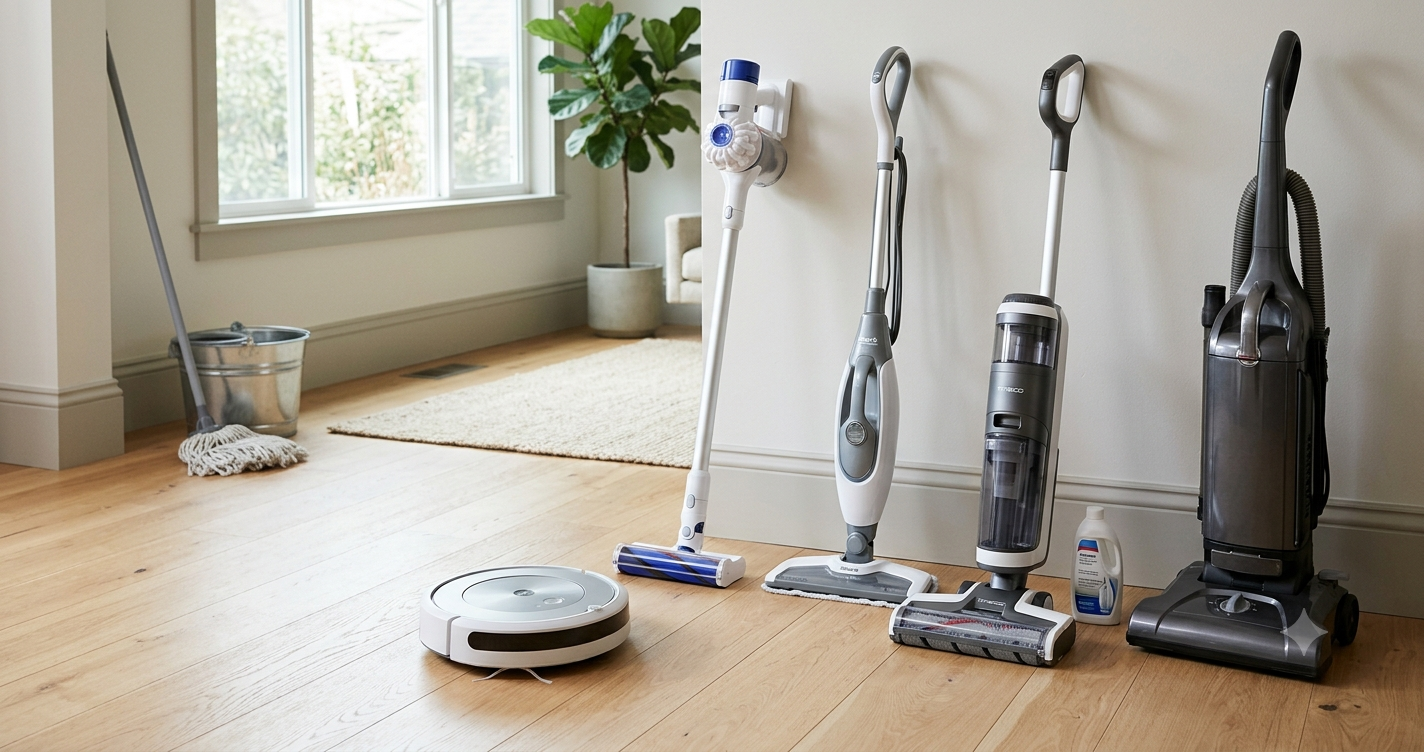
A practical guide to the modern ways to clean hard floors — robot vacuums, cordless sticks, steam mops, vacuum-mop combos, and uprights — based on what expert reviewers consistently recommend.

By: Michael Kuzma, Editor-in-Chief
Last Updated: June 2026
The traditional mop and bucket served humanity well for centuries. Dunk, wring, slap, drag, repeat. It got the job done. It also left your floors wet for 30 minutes, required wringing out a thing that smelled increasingly questionable, and never actually got the grout clean.
If you have hard floors (hardwood, tile, laminate, vinyl, or stone), you now have options that your grandparents would find deeply unfair. Machines that vacuum and mop at the same time. Robots that do both while you’re at work. Steam mops that sanitize without chemicals. Cordless vacuums you can grab off a wall mount and have the kitchen done in two minutes.
After reading through what Wirecutter, Consumer Reports, RTINGS, and other expert sources say about each of these categories, the picture is clear: there’s no single product that does everything perfectly, but the right combination of one or two of these replaces the mop and bucket entirely, takes less time, and produces cleaner floors.
Here’s what each option actually does, what it doesn’t do, and which one fits your situation.
Start Here: What Kind of Clean Do You Need?
Hard floor cleaning breaks down into two fundamentally different jobs, and most people conflate them.
Dry cleaning is picking up dust, crumbs, hair, and debris. This is what a vacuum does. It’s the daily maintenance task, and it accounts for about 80% of what makes a floor look (and feel) clean. If you only do one thing, do this.
Wet cleaning is dissolving sticky spots, removing stains, and sanitizing. This is what mopping does. It matters in kitchens and bathrooms more than anywhere else, and it doesn’t need to happen nearly as often as most people think. Weekly in high-traffic areas, less elsewhere.
The traditional mop and bucket combined both jobs badly. Modern tools split them into separate, optimized tasks, or combine them in ways that actually work.
Robot Vacuums (and Robot Mops)
Best for: Automated daily maintenance that happens while you’re doing literally anything else.
The robot vacuum is the single biggest quality-of-life upgrade for hard floor owners. Set a schedule, and it runs every day, keeping dust, hair, and crumbs at a baseline level of clean that you’d never achieve with manual vacuuming because you’d never vacuum that often. The best models now map your home, avoid obstacles, empty their own dustbins, and return to charge automatically.
Many modern robot vacuums also mop. Some use vibrating or rotating pads with built-in water tanks. Some lift their mop pads when they detect carpet so they can vacuum rugs without getting them wet. The mopping isn’t going to match a dedicated mop for tough kitchen grease, but for daily light mopping on top of vacuuming, it’s remarkably effective and requires approximately zero effort from you.
The trade-offs: robots can’t do stairs, they struggle with thick rugs, and they’re not great at deep scrubbing stuck-on messes. They also require some maintenance (brush cleaning, dustbin emptying, mop pad washing) though the self-emptying models reduce this significantly. And if your floors are cluttered with cords and socks and toys, you’ll need to tidy up before the robot can do its thing, which somewhat undermines the “automated” promise.
For daily hard floor maintenance, though, nothing else comes close to the effort-to-result ratio.
See our full review: Best Robot Vacuums
Cordless Stick Vacuums
Best for: Quick daily dry cleaning, spot messes, and the grab-it-when-you-see-a-crumb approach to life.
If a robot vacuum is the set-it-and-forget-it approach, a cordless stick is the grab-and-go approach. See crumbs under the table? Pull it off the wall mount, vacuum, put it back. Done in 90 seconds. No cord to find an outlet for, no bucket to fill, no robot to schedule. Just you, a lightweight stick, and a mess that’s now gone.
For hard floors specifically, cordless sticks are excellent. Hard surfaces are easier to clean than carpet (no fibers trapping dirt), so even mid-range sticks deliver great results on tile, hardwood, and laminate. Many come with specific hard floor attachments that are gentler on wood and better at picking up fine dust.
They don’t mop, though. A cordless stick handles the dry cleaning job and handles it well, but for sticky spots and real mopping, you need something else. One thing worth knowing: cordless stick vacuums run on lithium-ion batteries, and those batteries degrade over time. After two to four years of regular use, you’ll notice shorter runtime and weaker suction. On most models, the battery isn’t user-replaceable (or the replacement costs enough that you start eyeing new models anyway), which effectively means the vacuum has a lifespan in a way that a corded vacuum doesn’t. It’s not a reason to avoid them, but it’s worth factoring into the value equation. That said, if you pair a cordless stick with a robot that mops, or use it alongside a steam mop or vacuum-mop combo for periodic wet cleaning, you’ve got a system that covers everything.
See our full review: Best Cordless Stick Vacuums
Vacuum-Mop Combos
Best for: Doing the vacuuming and mopping in a single pass, especially in kitchens and high-traffic areas.
This is the category that most directly replaces the mop and bucket. Vacuum-mop combos vacuum dry debris and mop the floor simultaneously. They use dual tanks (clean water in, dirty water out), a powered brush roll that scrubs while suction pulls, and they leave floors clean and nearly dry in one pass. For the kitchen specifically, where you’re dealing with crumbs and sticky spots at the same time, these are hard to beat.
The category has matured fast. The best models now feature self-cleaning docks that wash and dry the brush roll automatically, smart sensors that detect how dirty the floor is and adjust water and suction accordingly, and some even add steam for extra sanitizing power. The BISSELL CrossWave HydroSteam Plus, for example, combines all three functions (vacuum, mop, and steam) in one machine.
The trade-offs are real, though. These machines require more maintenance than a standard vacuum. The dirty water tank needs to be emptied and cleaned after every use, or it gets genuinely unpleasant. Brush rolls need periodic replacement. And they’re designed for sealed hard floors only. Most can’t handle carpet (though a few can refresh low-pile area rugs).
They’re also not a replacement for a primary vacuum if you have carpeted areas elsewhere in the house. Think of them as a hard-floor-specific tool that happens to do two jobs at once.
See our full review: Best Vacuum-Mop Combos
Steam Mops
Best for: Chemical-free sanitization on sealed tile, stone, and porcelain floors.
Steam mops use hot steam to loosen dirt, dissolve grime, and kill bacteria without any cleaning chemicals. You fill a tank with water, wait 30-60 seconds for it to heat up, and glide it across the floor. The steam does the work, and a microfiber pad picks up what’s loosened. For tile and grout in kitchens and bathrooms, they’re excellent. The heat gets into grout lines in a way that traditional mopping never quite manages.
Here’s the important thing expert sources consistently emphasize: steam mops are not vacuums. They do not pick up dry debris. If you steam mop a dusty floor, you’re making what one cleaning expert memorably described as “hot mud.” You need to vacuum or sweep first, then steam mop. This two-step process is the single most common complaint about steam mops, and it’s worth knowing upfront.
The floor compatibility issue is also critical. Steam mops are safe on ceramic tile, porcelain, sealed stone, and linoleum. They are NOT safe on unsealed hardwood, laminate (unless specifically approved by the manufacturer), luxury vinyl plank, or waxed floors. The heat and moisture can cause warping, discoloration, or finish damage. This isn’t a theoretical risk. It’s a “you will ruin your floor” risk. Check your floor type before you buy.
The value proposition of steam mops is chemical-free sanitization. If that matters to you (pets, kids, allergies, personal preference), a steam mop is the best tool for the job. If you just want clean floors and don’t care about the chemical-free angle, a vacuum-mop combo is more versatile.
See our full review: Best Steam Mops
Upright and Canister Vacuums
Best for: Deep-cleaning large hard floor areas with sustained power, especially if you also have carpet.
Uprights and canisters might seem like an odd inclusion in a hard floor guide, but they deserve a mention for one specific situation: if you have a large home with a mix of hard floors and carpet, a full-size vacuum handles both surfaces better than any other single tool. Plug it in, and you get unlimited runtime with consistent suction across hardwood, tile, and then straight onto carpet without swapping machines.
Modern uprights and canisters typically include hard floor attachments or settings that turn off the brush roll (which can scatter debris on hard surfaces) and optimize for smooth floors. Canister vacuums are especially good here because the separate wand gives you reach under furniture and into corners that an upright can’t manage.
The trade-off is everything that makes full-size vacuums inconvenient: they’re heavy, they need a cord, they’re loud, and nobody grabs an upright for a quick crumb situation. If your home is primarily hard floors and you’re looking for the most practical daily tool, a cordless stick or robot is a better fit. The upright earns its place in mixed-floor homes where deep cleaning across both surfaces matters.
See our full review: Best Upright and Canister Vacuums
The Best Combinations
No single tool does everything perfectly on hard floors. Here are the combos that expert sources most frequently recommend:
Robot vacuum (with mopping) as your only machine. If your home is mostly open hard floors with minimal clutter, a modern robot vacuum-mop combo running daily might genuinely be all you need. It handles the daily dry and light wet cleaning automatically. You’d only need to supplement for heavy-duty messes or deep grout cleaning. This is the laziest option, and I mean that as a compliment.
Robot vacuum + steam mop. The robot handles daily maintenance. The steam mop comes out weekly (or less) for a deep, chemical-free clean on tile and stone. This is the best combo for kitchens and bathrooms with tile floors where sanitation matters.
Cordless stick + vacuum-mop combo. The stick handles everyday dry cleanup throughout the house. The vacuum-mop combo comes out for the kitchen and other hard floor areas where wet messes happen. This covers both jobs with purpose-built tools.
Robot vacuum + cordless stick. Daily automated cleaning plus a manual option for quick spot messes and stairs. This was the top combo in our Which Type of Vacuum Do You Actually Need? guide, and it works just as well from a hard-floor-specific perspective.
Any of these combos makes the mop and bucket fully redundant.
What Matters Less Than You Think
Suction power in pascals (Pa). Manufacturers love quoting suction numbers, and they mean almost nothing for hard floor cleaning. Hard floors are smooth. You don’t need 30,000 Pa to pick up cereal off tile. Suction matters for carpet. For hard floors, brush roll design and edge cleaning matter more.
“Sanitizes 99.9% of bacteria.” Almost every steam mop and many vacuum-mop combos make this claim. The testing conditions that produce this number (sustained contact on a specific surface for a specific duration) may not match how you actually use the product. It’s not untrue, but it’s also not as meaningful as it sounds. Don’t pick a product based on this claim alone.
Corded vs. cordless for vacuum-mop combos. Cordless models dominate the market and offer plenty of runtime for most homes. Corded models deliver unlimited runtime and sometimes more consistent suction, but the convenience gap is significant. Unless your home is very large, cordless is the right call.
Self-cleaning docks on vacuum-mop combos. These are genuinely useful, but they don’t eliminate maintenance. They automate the brush roll cleaning and drying, which is the most annoying part. But you still need to empty the dirty water tank, refill the clean water tank, and occasionally deep-clean the dock itself. “Self-cleaning” is an overstatement. “Mostly-self-cleaning” is more accurate.
Every category linked above has a full expert consensus review with specific model recommendations, trade-offs, and how the major review sources compare. We update them regularly as expert recommendations change.
For help choosing between vacuum types specifically, see our dedicated guide:
Full reviews in each category: