
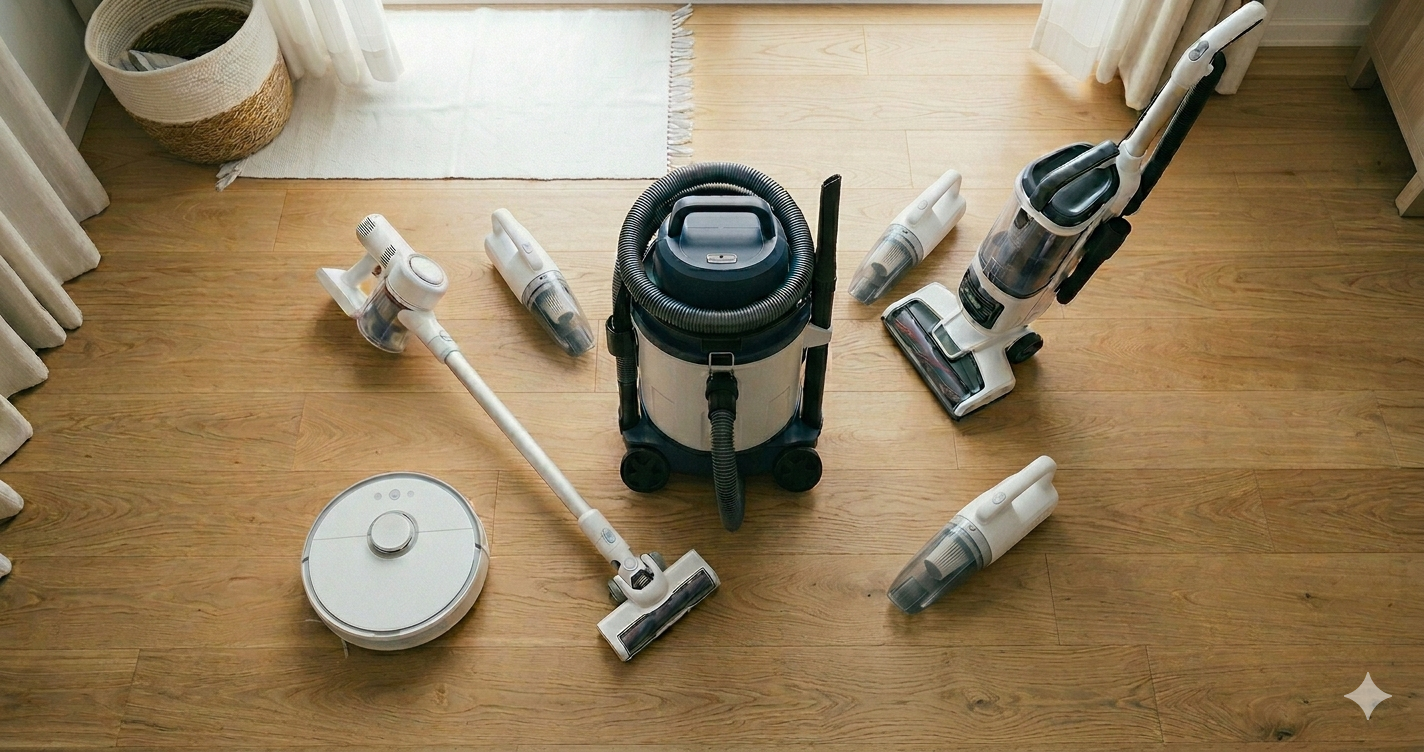
A practical guide to choosing between robot, cordless stick, upright, handheld, and shop vacuums — based on what expert reviewers consistently recommend.

By: Michael Kuzma, Editor-in-Chief
Last Updated: May 2026
Nobody needs five vacuums. At least, that’s what I tell myself while looking at the three in my closet.
The vacuum market has gotten ridiculous. Robot vacuums that mop and empty themselves. Cordless sticks that cost more than my first car. Shop vacs that could probably suck the chrome off a bumper. They all exist because they solve genuinely different problems. The trick is figuring out which problem is actually yours.
After spending months reading through what Wirecutter, Consumer Reports, RTINGS, and a bunch of other expert review sources have to say about each type, a few patterns jump out. No single vacuum type is best for every home. But most homes really only need one or two, and the right choice depends more on your floors, your lifestyle, and your personal relationship with the chore of vacuuming than it does on any spec sheet.
Here’s how to think about it.
Start Here: What Does Your Home Actually Need?
Before you fall down a rabbit hole comparing suction specs (which — spoiler alert — don’t matter as much as you think), answer these four questions. They’ll point you to the right type faster than any comparison chart.
- What are your floors? Mostly hardwood and tile? Almost any vacuum type will work. Wall-to-wall carpet, especially the thick stuff? You need something with a motorized brush roll and real, sustained suction. That usually means an upright or a higher-end cordless stick. Sorry, there’s no shortcut here.
- How many levels does your home have? Multi-story homes create a practical problem that nobody talks about enough. Dragging a full-size upright up and down stairs is the kind of workout nobody asked for. This is where a second, lighter vacuum earns its place.
- Do you have pets? Pet hair changes everything. It gets into everything, it accumulates faster than you’d believe, and it doesn’t care about your cleaning schedule. You’ll want something you can run frequently without it feeling like a whole production. That might mean a robot for daily maintenance, a cordless stick for quick pickups, or both. (Dog people, you know what I’m talking about.)
- How much do you actually want to vacuum? Be honest with yourself here. If the answer is “as little as humanly possible,” a robot vacuum that runs on a schedule might be the best money you’ve ever spent. If you don’t mind the task and want a truly thorough clean, a traditional upright will outperform anything else at pulling dirt out of carpet. No judgment either way.
Robot Vacuums
Best for: Daily maintenance cleaning, pet hair management, people who view vacuuming the way most people view doing taxes.
Robot vacuums have gotten remarkably good. The best ones map your home, avoid obstacles, empty their own dustbins, and even mop. You set a schedule and they just run, keeping your floors in a baseline state of clean between deeper sessions. It’s the closest thing to having a cleaning service that doesn’t judge your furniture choices.
But they’re not a replacement for a traditional vacuum. They handle surface-level dust and hair well, but they can’t match the deep-cleaning power of an upright on carpet. They can’t do stairs. They struggle with high-pile rugs and cluttered floors. And when something goes wrong (a stuck wheel, a rogue sock incident), you’re troubleshooting a robot instead of just vacuuming.
The sweet spot is using a robot for the daily stuff and pairing it with a stick or upright for the weekly deep clean. Multiple expert sources recommend exactly this combo, and they’re right.
Who should skip them: Anyone with lots of stairs, heavily cluttered floors, or primarily thick carpet. Also anyone who finds the idea of babysitting a robot more annoying than just pushing a vacuum themselves.
For specific models and expert consensus picks, see our full Best Robot Vacuums review.
Cordless Stick Vacuums
Best for: Quick daily cleanups, small to medium homes, people who want to grab something off a wall mount and be done in five minutes.
Cordless sticks are the Swiss army knife of vacuums. Light enough to grab on impulse, powerful enough for most everyday messes, and many convert to a handheld for furniture and car interiors. They’re the vacuum you’ll actually use every day because there’s no cord to untangle, no outlet to hunt for, and no existential dread about dragging out the big machine.
The trade-off is runtime. Most give you 20 to 40 minutes on the standard power setting, less on high. For a small apartment, that’s plenty. For a 2,500-square-foot house with lots of carpet, you might run out of battery before you run out of floor. Nothing kills momentum like a vacuum that needs a nap.
They’ve also gotten powerful enough that the gap between a good cordless stick and a mid-range upright has narrowed significantly. For hard floors, the best sticks clean just as well. On carpet, uprights still win, but it’s closer than it used to be.
Who should skip them: Anyone with a large, heavily carpeted home who wants to clean the whole thing in one go. The battery limitation is real, and no amount of marketing spin changes physics.
For specific models and expert consensus picks, see our full Best Cordless Stick Vacuums review.
Upright and Canister Vacuums
Best for: Deep cleaning carpet, large homes, anyone who wants maximum suction and doesn’t mind a cord.
The full-size upright is the aging workhorse that refuses to retire. But it’s earned its keep — plug it in, and you get sustained, powerful suction for as long as you need it. No battery to die, no dock to return to. For thick carpet, nothing else comes close. The motorized brush roll combined with strong airflow pulls dirt out of carpet fibers that other vacuum types leave behind.
Canister vacuums offer a different form factor with similar cleaning power. The motor and dustbin sit in a unit that rolls behind you while you clean with a wand and hose. They’re more versatile for stairs, upholstery, and weird corners, though dragging a canister around takes some getting used to. It’s a bit like walking a very obedient, very loud dog.
The downside is bulk. Full-size vacuums are heavier, take up more closet space, and the cord limits your range. They’re not the vacuum you grab for a quick crumb situation.
Who should skip them: People in small apartments where closet space is already a negotiation, anyone who prioritizes convenience over deep-cleaning power, or anyone who just knows in their heart they won’t bother dragging out a full-size machine regularly. Self-awareness is an underrated vacuum-buying skill.
For specific models and expert consensus picks, see our full Best Upright and Canister Vacuums review.
Handheld Vacuums
Best for: Quick spot cleanups, car interiors, crumbs on counters, and that thing your kid just spilled.
Handhelds are the vacuum you keep in a kitchen drawer or a closet near the dining table. They exist for the five-second job: cereal on the floor, crumbs on the couch, dust on a shelf, pet hair on a car seat. They’re small, light, and always ready.
They’re not meant to clean your whole house. Trying to vacuum a living room with a handheld is like trying to mow a lawn with scissors. The dustbin is tiny, the battery is short, and the suction is modest compared to anything full-size. But for the specific job they’re built for, they’re genuinely great.
Think of them as a complement, not a primary vacuum. A handheld plus a robot, or a handheld plus a cordless stick, covers a surprisingly wide range of cleaning situations without ever dragging out anything heavy.
Who should skip them: Anyone who already owns a cordless stick that converts to a handheld. A lot of them do, and you might already have this capability without realizing it. Check your attachments before you buy a separate device.
For specific models and expert consensus picks, see our full Best Handheld Vacuums review.
Shop Vacuums (Wet/Dry Vacs)
Best for: Garages, workshops, basements, post-renovation cleanup, and any situation where the mess would make a regular vacuum file for divorce.
Shop vacs are in a completely different weight class from household vacuums. They’re built to handle things that would destroy a regular vacuum in seconds: drywall dust, wood shavings, standing water, gravel, broken glass. If you have a garage, a workshop, or you do any kind of DIY projects, a shop vac isn’t optional. You’ll learn that the first time you try to clean up sawdust with a Dyson.
They’re also the vacuum you want after a plumbing mishap or a basement flood. The wet pickup capability is something no other vacuum type offers, and you will never appreciate a shop vac more than when you need one and actually have one.
The trade-offs are obvious. They’re loud (like, conversation-ending loud), bulky, and absolutely not something you’d use on your living room carpet. They’re a specialty tool, and they’re excellent at their specialty.
Who should skip them: Anyone whose cleaning needs are purely indoor residential. If you’ve never looked at a mess and thought “a normal vacuum cannot handle this,” you probably don’t need one. Yet.
For specific models and expert consensus picks, see our full Best Shop Vacuums review.
The Case for Owning Two
Here’s something that comes up over and over across expert sources, and it’s advice I wish someone had given me years ago: most households are better off with two vacuums that each do their job well than one vacuum that tries to do everything.
The most commonly recommended pairings:
Robot + cordless stick. The robot handles daily maintenance on autopilot. The stick comes out for targeted cleanups, stairs, and spots the robot missed. This is the combo experts recommend most often for homes that are mostly hard floors with some area rugs. It’s also the combo where you technically vacuum every day but it barely feels like it.
Cordless stick + upright. The stick handles everyday messes and hard floors. The upright comes out weekly for a thorough deep clean on carpet. Works well for larger homes with a mix of floor types.
Robot + upright. The robot keeps things tidy between sessions. The upright does the real work on carpet once a week. Good for larger carpeted homes where a stick vacuum doesn’t have the power or runtime to keep up.
In any of these pairings, a handheld is a low-cost add-on for quick spot jobs, though many cordless sticks already convert to fill that role. Don’t buy one until you’ve checked.
What Matters Less Than You Think
A few things that get a lot of marketing attention but that expert reviewers consistently shrug at:
Wattage and suction numbers. These specs are great for winning arguments on the internet and almost useless for predicting how well a vacuum actually cleans. Real-world performance depends on airflow design, brush roll effectiveness, and filtration, not peak suction in a lab. Don’t pick a vacuum the way you’d pick a truck engine.
Bagless vs. bagged. This is mostly a preference. Bagged vacuums tend to maintain suction better as they fill and are gentler on allergy sufferers. Bagless saves on ongoing costs. Neither is categorically better, and anyone who insists otherwise is more passionate about vacuum bags than the situation warrants.
Smart features on robot vacuums. Auto-empty docks are genuinely useful. App-based room mapping is convenient. But beyond those two, most smart features (voice control, camera monitoring, custom cleaning zones) are nice-to-haves that don’t affect how well the thing actually cleans your floor.
For expert consensus picks in each category, including specific model recommendations, trade-offs, and how the major review sources compare, see our detailed reviews: