
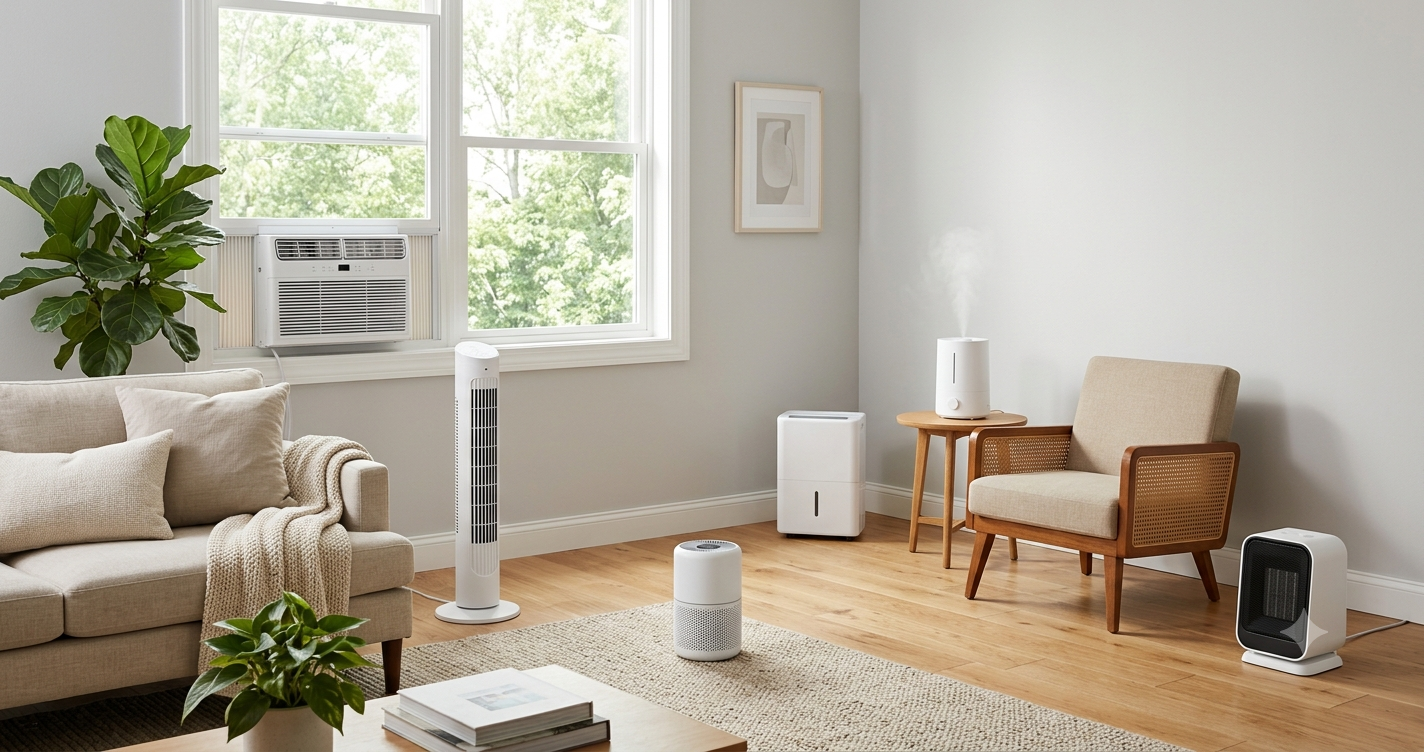
A practical guide to air conditioners, cooling fans, air purifiers, dehumidifiers, humidifiers, and space heaters — and figuring out which ones you actually need.

By: Michael Kuzma, Editor-in-Chief
Last Updated: June 2026
Nobody thinks about the air in their house until something is wrong with it. Too hot, too cold, too humid, too dry, too dusty, too smelly, too “why is there mold growing behind the dresser.” Indoor air has a lot of ways to be bad, and each one has a different appliance that fixes it. The trick is diagnosing the actual problem before you buy the wrong solution.
These six categories are all technically about “indoor air” but they solve completely different things. An air conditioner cools. A fan circulates. A space heater warms. A dehumidifier removes moisture. A humidifier adds it. An air purifier filters particles. They’re not interchangeable, and the number of people who buy an air purifier hoping it’ll cool a room down is higher than the industry would like to admit.
After reading through what Consumer Reports, Wirecutter, RTINGS, HouseFresh, and other expert sources have to say about each of these, the pattern is clear: most homes need two or three of these at different times of year, almost nobody needs all six, and diagnosing your actual problem saves you from buying something that sits in a closet generating regret.
Start Here: What’s Actually Bothering You?
Before you buy anything, figure out which of these sounds like your house.
“This room is unbearably hot in summer.” You need an air conditioner. A fan will make you feel cooler by moving air across your skin, but it won’t actually lower the room temperature. If you can’t install an AC or you’re dealing with mild warmth rather than real heat, a fan is a much cheaper and more energy-efficient option. But when it’s genuinely hot, only an AC removes heat from the room.
“It’s warm but not AC-level warm” or “the air feels stuffy and stagnant.” A cooling fan might be all you need. Fans don’t lower the temperature, but they create airflow that makes a room feel several degrees cooler and breaks up that stale, still-air feeling. They use a fraction of the electricity an AC does, and they’re useful in rooms where you don’t want to run the AC all day, like a home office or bedroom at night.
“This room is always cold.” You need a space heater. They’re cheap, they’re targeted, and they let you warm one room without cranking the thermostat for the whole house. If your entire house is cold, that’s an HVAC problem, not a space heater problem.
“My allergies are terrible indoors.” You probably need an air purifier. HEPA filtration captures dust, pollen, pet dander, and other particles that trigger allergies. If you’re also dealing with high humidity, a dehumidifier helps too, since dust mites and mold thrive in humid conditions.
“The basement smells musty” or “there’s condensation on the windows.” Dehumidifier. Excess moisture causes mold, mildew, musty smells, and eventually structural damage. This is one of those problems where the fix is boring and the consequences of ignoring it are expensive.
“My skin is cracking and my nose is bleeding.” Humidifier. Dry winter air drops indoor humidity below comfortable levels, and your body notices. Your hardwood floors notice too.
“The air just feels… bad.” Start with an air purifier and see if it helps. “Bad air” is vague, but a HEPA filter will handle most of the invisible stuff (dust, dander, smoke particles) that makes indoor air feel stuffy or irritating.
Air Conditioners
The problem it solves: A room that’s too hot.
This is the one most people are shopping for, and it’s also the one with the most consequential “which type” decision. Window units and portable units are fundamentally different in performance, and expert sources are clear about which one wins.
Window ACs are more efficient, quieter, and cool better. They sit in your window, vent hot air directly outside, and use less electricity doing it. If you can install one (you have a compatible window and no HOA or landlord preventing it), this is the right choice. Modern window units are dramatically quieter than the ones you remember from your childhood, and some designs even let you open and close the window while the AC is installed.
Portable ACs are more flexible but less effective. They sit inside the room and vent hot air through a hose to the window. The trade-off is that most portables use a single hose, which creates negative pressure that pulls warm air back into the room through every gap and crack. This is an actual physics problem, not a marketing disadvantage. Dual-hose models solve it but cost more. If a window unit isn’t an option, get a dual-hose portable. Single-hose is a last resort.
Expert sources are unanimous on this: if you can install a window AC, do that instead of buying a portable. It will cool better, cost less to run, and be quieter. Portables exist for situations where a window unit genuinely won’t work.
See our full review: Best Air Conditioners
Cooling Fans
The problem it solves: A room that feels stuffy, stale, or mildly warm.
Fans are the most underrated appliance on this list. They’re cheap, they use almost no electricity, they’re easy to move around, and in a surprising number of situations, they’re all you actually need. Not every warm room needs an air conditioner. Sometimes you just need air moving.
The key thing to understand: fans don’t cool the air. They cool you. Moving air accelerates evaporation from your skin, which makes you feel several degrees cooler even though the room temperature hasn’t changed. This is why a fan in an empty room is doing nothing useful, and why a fan blowing on you while you work or sleep can be the difference between comfortable and miserable.
There are four main types, and each fits a different situation.
Air circulators (like the Vornado models that experts have been recommending for nearly a decade) move air in a spiral pattern that fills the entire room rather than blowing a direct stream at you. They’re compact, powerful relative to their size, and excellent for general air circulation. If you only buy one fan, this is probably the type.
Tower fans are tall, slim, and oscillate to sweep air across a wide area. They’re quieter than most circulators on low settings, take up very little floor space, and look less industrial than a round fan sitting on the floor. Good for bedrooms and living rooms where you want airflow without the visual presence of a chunky fan.
Pedestal fans stand on an adjustable pole and deliver strong, directed airflow at whatever height you set them. They cover larger areas than desk fans and are easy to reposition. The trade-off is that they take up more floor space than tower fans.
Desk fans are the personal option. Small, quiet (usually), and designed to sit on a desk or nightstand and blow air directly at one person. They’re the fan you keep in your home office to avoid running the AC for a single room.
One more thing: fans pair brilliantly with air conditioners. Running a fan in a room with an AC lets you set the thermostat a few degrees higher while feeling just as cool, which saves real money on electricity over a summer. Expert sources consistently recommend this combination as the most energy-efficient approach to staying comfortable.
See our full review: Best Cooling Fans
Air Purifiers
The problem it solves: Airborne particles you don’t want to breathe.
Air purifiers are the most misunderstood product on this list. They don’t cool the air. They don’t add or remove moisture. They filter particles: dust, pollen, pet dander, smoke, mold spores. If those things bother you (allergies, asthma, pets, wildfire smoke season, or just a general preference for not inhaling dust), an air purifier helps. If your issue is temperature or humidity, an air purifier will not fix it no matter how expensive it is.
The core technology is HEPA filtration, and it works. The performance gap between budget and premium units has narrowed significantly, so you don’t need to spend a fortune. What varies more meaningfully is how much air the unit can process (measured as Clean Air Delivery Rate, or CADR), how loud it is while doing it, and how expensive the replacement filters are. That last point is the one people underestimate. A cheap purifier with expensive filters costs more over time than a pricier purifier with affordable replacements.
Room size matching matters. An air purifier rated for 200 square feet will struggle in a 400-square-foot living room. Check the CADR rating against your actual room size, and if you’re between sizes, go bigger. Running a too-small purifier on high is louder and less effective than running a properly sized one on medium.
One thing expert sources consistently warn about: be skeptical of “HEPA-type” or “HEPA-like” marketing language. True HEPA has a certified performance standard (99.97% of particles at 0.3 microns). Anything that hedges with “type” or “style” may not meet it. Look for the real thing.
See our full review: Best Air Purifiers
Dehumidifiers
The problem it solves: Too much moisture in the air.
Dehumidifiers are the unglamorous workhorse of this list. Nobody gets excited about buying one, nobody shows it off to guests, and it might be the most important appliance in your basement. Excess humidity causes mold, mildew, musty smells, wood rot, and creates an environment where dust mites thrive. If your basement smells damp, your windows fog up regularly, or you’ve seen any hint of mold, a dehumidifier isn’t optional. It’s damage prevention.
The main spec that matters is pint capacity, which tells you how much moisture the unit can remove in 24 hours. A 20-pint model handles bedrooms and smaller spaces. A 50-pint model handles basements and larger areas. When in doubt, go bigger. A larger dehumidifier running on a lower setting is quieter and more efficient than a smaller one running at full power.
The biggest usability complaint in this category, across basically every expert source, is emptying the water tank. Dehumidifiers collect water, and unless you set up continuous drainage through a hose or a built-in pump, you’re manually emptying a bucket. In a basement, that means carrying a heavy bucket up stairs. This sounds minor until you’re doing it every day in August. If your dehumidifier is going in the basement, prioritize models with a built-in pump or a gravity drain option. Your future self will appreciate it.
One more thing: the dehumidifier market has been hit hard by recalls and discontinuations in recent years. Multiple brands have recalled units for overheating and fire risks. This is a category where buying from established brands with good track records matters more than finding the cheapest option. Expert sources have documented which brands have reliability issues and which don’t.
See our full review: Best Dehumidifiers
Humidifiers
The problem it solves: Air that’s too dry.
If dehumidifiers are for summer basements, humidifiers are for winter everything. When outdoor temperatures drop, heating systems dry out indoor air, sometimes to levels that are genuinely uncomfortable. Cracked skin, bloody noses, static electricity that makes touching a doorknob feel like a medical event, and waking up with a throat that feels like sandpaper. A humidifier adds moisture back.
There are two main types, and they work differently. Cool mist humidifiers (including ultrasonic and evaporative models) add moisture without heating the water. They’re safer around kids and pets, use less energy, and work well in mild to moderate dry conditions. Warm mist humidifiers boil water before releasing steam, which also has a mild sterilizing effect. They’re quieter (no fan needed), but they use more electricity and pose a burn risk.
Expert sources generally lean toward cool mist for most households. Evaporative models (which use a fan to blow air through a wet wick) are self-regulating: they naturally slow down as humidity rises, which makes them harder to over-humidify with. Ultrasonic models are quieter but can leave a fine white mineral dust on nearby surfaces if you use hard water without a demineralization cartridge. This isn’t harmful, but it’s annoying, and nobody warns you about it until you’ve already bought one.
Cleaning is the non-negotiable maintenance task. A dirty humidifier doesn’t just stop working well; it can actually make your air quality worse by dispersing bacteria and mold into the air. Expert sources recommend cleaning the tank every few days and replacing wicks or filters on schedule. It’s not hard, but it’s the kind of thing people forget about and then wonder why their humidifier smells weird.
See our full review: Best Humidifiers
Space Heaters
The problem it solves: A room that’s too cold.
Every house has that one room. The bedroom that’s always five degrees colder than the rest of the house. The home office over the garage. The sunroom that’s lovely in June and uninhabitable in January. A space heater is the targeted fix: warm the room you’re in without heating the rooms you’re not.
There are several types, and they produce different kinds of heat. Ceramic heaters are the most common. They heat up fast, they’re compact, and they’re good for personal warmth at a desk or in a small room. Radiant heaters warm objects directly (including you) rather than the air, which feels more natural and is more efficient in drafty spaces. Oil-filled radiators heat slowly but hold their warmth for a long time and run nearly silently, which makes them excellent for bedrooms.
Safety is the one area where space heaters demand respect. They’re responsible for a disproportionate number of residential fires, usually because someone placed one too close to something flammable or left it running unattended. Buy one with tip-over shutoff, overheat protection, and a timer. And don’t plug it into a power strip. Space heaters draw enough current that they should go directly into a wall outlet. This isn’t a suggestion.
Space heaters are a supplemental solution, not a replacement for central heating. If your entire house is cold, the problem is your HVAC system, your insulation, or both. A space heater in every room is expensive, potentially dangerous, and a sign that you need to address the root cause.
See our full review: Best Space Heaters
The Seasonal Calendar
Most of these appliances have a season, and knowing when you’ll need them helps you buy ahead instead of panic-purchasing during a heat wave or cold snap (when prices spike and popular models sell out).
Spring: Allergy season makes this the time to set up an air purifier if you haven’t already. Also a good time to check on your dehumidifier before summer humidity arrives. If you’ve been relying on your heating system all winter, pulling out a fan for air circulation feels surprisingly good.
Summer: Air conditioner, fan, and dehumidifier season. If your basement gets damp, the dehumidifier should be running. If your upstairs is hot, the AC should be installed before the first heat wave, not during it. Buying an AC in July is like buying a snow blower in January. You’ll pay more and the good ones will be sold out. Fans supplement the AC everywhere else.
Fall: Wind down the AC and dehumidifier. If you have a humidifier, check the filters and wicks before heating season starts. Air purifiers run year-round if you have allergies or pets.
Winter: Space heater and humidifier season. If you live in wildfire-prone areas, the air purifier stays relevant through fall and into winter too.
Do You Need More Than One?
Probably, but not all at once. Here’s how they overlap:
Air conditioner + fan is the energy-smart summer combo. The AC does the heavy lifting on temperature, and the fan circulates the cooled air so you can set the thermostat a few degrees higher. Expert sources consistently recommend this as the most cost-effective way to stay cool.
Air purifier + dehumidifier is the most common combo for homes with allergies and a damp basement. They solve completely different problems and don’t interfere with each other.
Air conditioner + dehumidifier makes sense because cooling air naturally reduces humidity somewhat, but in seriously humid climates, the AC alone isn’t enough. Running both keeps the air cool and dry.
Humidifier + space heater is the winter duo. The heater warms the room, the humidifier counteracts the dryness that heating creates. Just don’t put them right next to each other.
Air purifier + humidifier works in winter when you want clean air and added moisture. Some brands make combo units that do both, though expert sources generally recommend separate devices for better performance in each function.
The one combo you don’t want: humidifier + dehumidifier in the same room at the same time. If you find yourself doing this, something else has gone wrong.
What Matters Less Than You Think
Smart features. App connectivity and voice control are nice conveniences on any of these appliances, but they don’t affect how well the unit heats, cools, purifies, or adjusts humidity. Don’t pay a significant premium for smart features unless you specifically want scheduling and remote control.
Ionizers on air purifiers. Some purifiers include built-in ionizers, and expert sources are split on whether they’re helpful or harmful. Most ionizers produce trace ozone as a byproduct, which some experts flag as a concern. If you’re buying a purifier for health reasons, you can skip the ionizer and lose nothing.
Exact BTU calculations for space heaters. Most residential space heaters produce roughly the same heat output (around 1,500 watts, which is the limit for a standard 15-amp outlet). The difference between models is in how they distribute that heat, not how much they produce. Don’t overthink the specs.
Noise levels on dehumidifiers. Every dehumidifier is loud. Some are louder than others, but none of them are quiet. If your dehumidifier is in the basement, this doesn’t matter. If it’s in a bedroom, it matters a lot, and you should look at compact models designed for quieter operation.
Every category linked above has a full expert consensus review with specific model recommendations, trade-offs, and how the major review sources compare. We update them regularly as expert recommendations change.
For the full review in each category:
- Best Air Conditioners
- Best Cooling Fans
- Best Air Purifiers
- Best Dehumidifiers
- Best Humidifiers
- Best Space Heaters
For help choosing between product types in other areas of your home, see our other buying guides: