
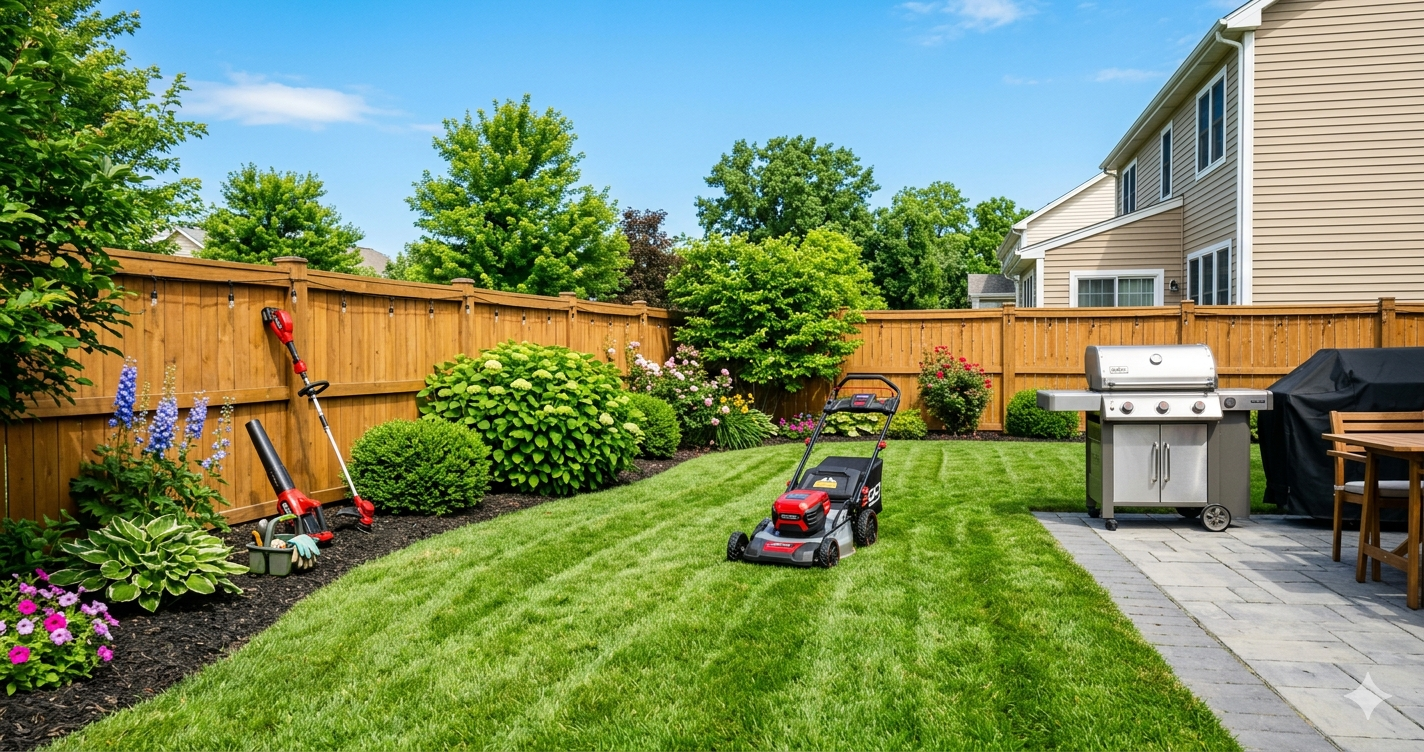
A practical guide to the outdoor tools and equipment worth buying right — based on what expert reviewers consistently recommend.

By: Michael Kuzma, Editor-in-Chief
Last Updated: May 2026
Spring arrives and your yard immediately starts making demands. The grass needs cutting. The edges need trimming. The hedges have opinions about their shape. The driveway looks like it’s been through something. And somewhere in the back of your mind, you’re thinking about a grill, because what’s the point of having outdoor space if you’re not going to cook on it.
The outdoor tool market wants you to buy one of everything, preferably gas-powered and overkill for your lot. But after reading through what Consumer Reports, Wirecutter, Pro Tool Reviews, and other expert sources have to say, the reality is simpler than the hardware store makes it look. Most suburban yards need four or five tools, battery-powered handles almost everything, and the grill is its own separate conversation (but an important one).
Here’s what you actually need, what can wait, and where it’s worth spending a little more.
The Essentials: Lawn Care
These are the tools you’ll use every week from spring through fall. They’re the core of yard maintenance, and they’re where buying the right thing pays off the fastest in time and frustration saved.
Lawn Mower
You know you need one. The question is what kind. And for the majority of suburban lots (a quarter acre or less), the answer from expert sources is increasingly clear: battery-powered. They’re quieter, they start instantly, they don’t smell like a gas station, and the best ones match gas performance for residential-sized lawns.
The main trade-off is runtime. Most battery mowers give you 30-60 minutes on a charge, which handles the typical suburban lawn in a single pass. If your property is large or you regularly let the grass get away from you, you might need a second battery or a higher-capacity model. But for the lawn most people actually have, battery is plenty.
Self-propelled is worth the upgrade if you have any slope at all. Pushing a mower uphill is fine the first time. By the fourth lap, you’ll wish you’d spent the extra money.
See our full review: Best Battery-Powered Lawn Mowers
String Trimmer
The thing that makes your lawn look like you actually care. After mowing, a quick pass with a string trimmer along the edges, around trees, and along fence lines is the difference between “mowed” and “maintained.” It takes five minutes and the visual impact is disproportionate.
Battery trimmers are the default recommendation from most expert sources for residential use. They’re powerful enough, they’re light, and if you buy into the same battery platform as your mower, you save money on batteries and chargers. That ecosystem thing is worth thinking about before you buy your first tool, because switching platforms later means buying all new batteries.
The one exception: if you have heavy brush or a very large property, a gas trimmer still has the edge on raw power and runtime. For most people’s yards, though, battery wins on convenience by a wide margin.
See our full review: Best String Trimmers
Leaf Blower
Not just a fall tool. Leaf blowers clear grass clippings off the driveway after you mow, blow debris out of the garage, clean off patios and walkways, and handle leaves when autumn eventually shows up. You’ll use this year-round, which is why it earns a spot in the essentials rather than the “nice to have” list.
Battery models are the default here too. They’re powerful enough for residential lots, and they won’t make your neighbors contemplate violence at 8:00 a.m. on a Saturday, which is a genuine consideration with gas blowers. Corded electric is the budget option if you don’t mind managing a cord, and they’re actually lighter than most battery models since there’s no battery weight.
See our full review: Best Leaf Blowers
The Second Tier: Worth Having, Not Urgent
These tools aren’t weekly-use items, but they solve real problems when you need them. Buy them as the need arises rather than all at once.
Hedge Trimmer
If you have hedges, you need this. If you don’t have hedges, you don’t. It’s one of the more binary purchases in this guide. Well-maintained hedges look great. Neglected hedges look bad faster than almost any other landscaping element, and hand-trimming with shears is the kind of activity that sounds therapeutic for about three minutes before you reconsider your decisions.
Battery-powered models dominate the expert recommendations for residential use. They’re lighter than gas, powerful enough for typical hedges, and don’t require the mixed-fuel situation that gas hedge trimmers demand. Corded models are cheaper and lighter still, though managing a cord while working around a tall hedge takes some patience.
See our full review: Best Hedge Trimmers
Pressure Washer
The tool you don’t think you need until you use one for the first time, and then you want to pressure wash everything you own. Driveways, sidewalks, decks, patios, siding, outdoor furniture, the garage floor. The before-and-after is genuinely dramatic.
Electric models handle most residential jobs. They’re easier to set up, quieter, and require basically no maintenance. Gas models deliver more power for tougher jobs (oil stains, heavily weathered decks, paint prep) but they’re louder, heavier, and need the same maintenance as any small gas engine. For most homeowners, electric is the right call unless you’re planning to strip a deck or clean a very long driveway regularly.
Fair warning: once you pressure wash your driveway, the clean strip next to the dirty part will bother you until you finish the whole thing. Budget your afternoon accordingly.
See our full review: Best Pressure Washers
The Grill
This gets its own section because it’s not a tool. It’s a lifestyle decision disguised as a purchase. A grill turns your backyard into a second kitchen, and if you use it regularly, it’s one of the best quality-of-life upgrades that comes with having outdoor space.
Gas vs. Charcoal
This is the big decision, and expert sources generally frame it the same way: gas is more convenient, charcoal tastes better. How much you care about each determines your pick.
Gas grills light with a button, reach cooking temperature in 10 minutes, offer precise temperature control, and clean up without dealing with ash. They’re the weeknight grill. The grill you fire up for burgers on a Tuesday because it’s easy. If you want to grill frequently with minimal friction, gas is the answer.
Charcoal grills require more effort (lighting, temperature management, ash cleanup) but deliver a smoky flavor that gas can’t replicate and offer more versatility for indirect cooking and smoking. They’re the weekend grill. The grill for when the cooking itself is part of the experience, not just a means to dinner. They’re also significantly cheaper for comparable build quality, which is a nice bonus.
A lot of serious grillers end up owning both. A gas grill for convenience and a charcoal kettle for when they want to do it properly. If you’re buying your first grill, start with whichever matches how you’ll actually use it most often. You can always add the other one later.
See our full review: Best Barbecue Grills
Electric Grills
If you live in a condo, apartment, or anywhere with a balcony instead of a yard, or if your HOA has banned open flames (and a surprising number of them have), an electric grill is your path to outdoor cooking. Modern electric grills get hot enough to sear properly, which wasn’t always the case with older models. They’re not going to replace a full-size gas or charcoal grill for someone with a backyard, but for small-space outdoor cooking, they’ve gotten legitimately good.
See our full review: Best Electric Grills
The Battery Platform Decision
One thing worth mentioning before you start buying: if you’re going battery-powered (and you probably should for most of these), try to stay within one battery platform. EGO, Ryobi, Milwaukee, DeWalt, and others each have their own battery ecosystems where the same batteries work across multiple tools. Buying a mower, trimmer, and blower from the same brand means you share batteries and chargers across all of them, which saves real money and means you always have a charged battery available.
This doesn’t mean you need to buy everything at once. It means when you buy your first battery tool, you’re also choosing a platform for the tools that follow. Pick based on the tool category that matters most to you (usually the mower, since it’s the biggest investment), and then fill in the rest from the same family.
What Can Wait Until You Actually Need It
Chainsaw. Unless you have a property with trees that regularly drop limbs, this is a buy-it-when-you-need-it tool. Most homeowners use a chainsaw a few times a year at most.
Shop vac. Incredibly useful for garage and workshop cleanup, but not a summer-specific purchase. Buy one when you do your first home project that generates the kind of mess a regular vacuum can’t handle.
Camping tent. Summer makes you want to go camping, and maybe you should. And what kids don’t love camping in a backyard? But tents are a researched purchase, not an impulse purchase. Take your time on this one.
Every category linked above has a full expert consensus review with specific model recommendations, trade-offs, and how the major review sources compare. We update them regularly as expert recommendations change.
For help choosing between product types within a category, see our other buying guides: